Technical English Doesn't Need to Be Complicated.
Download your free guide:
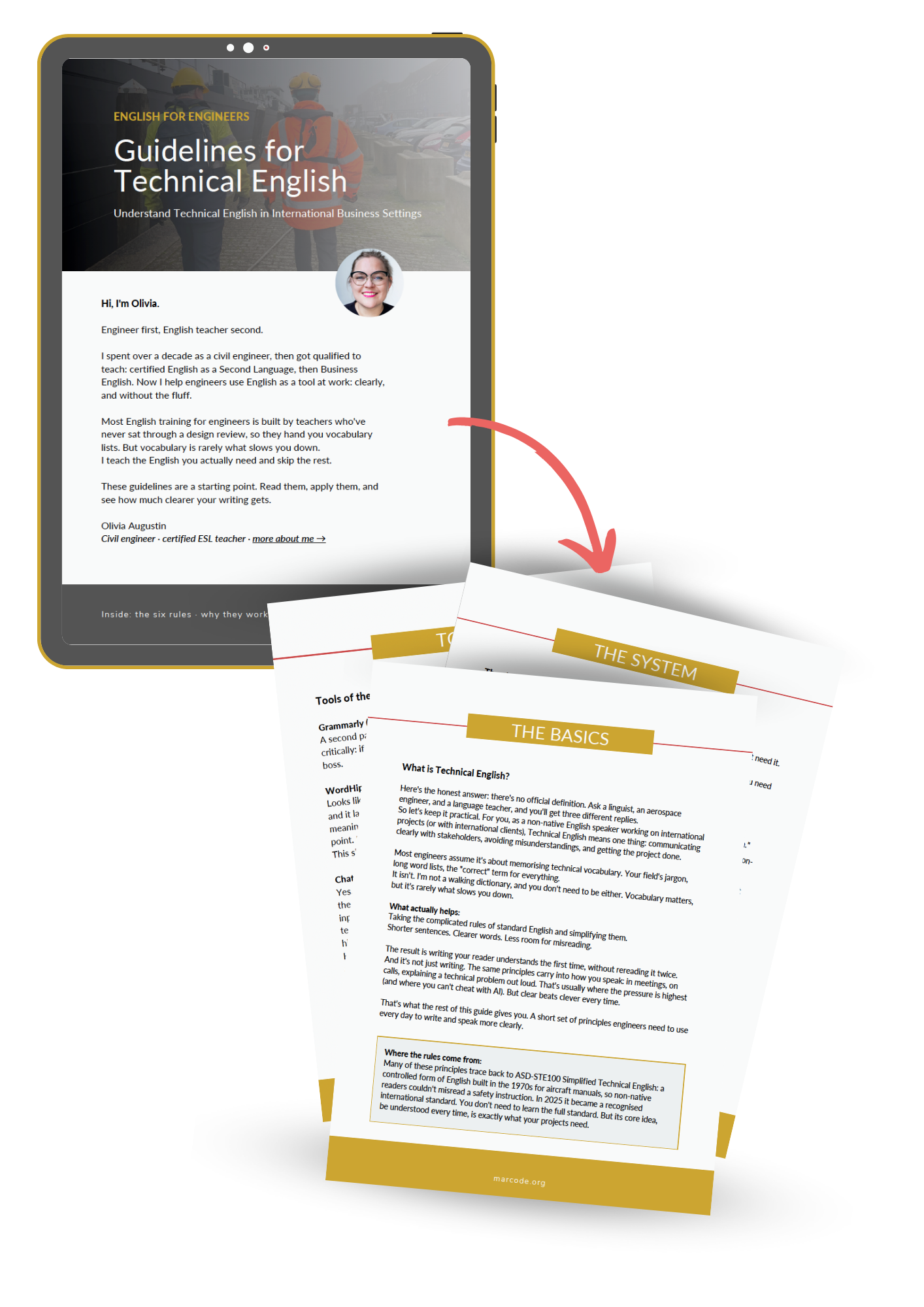
Guidelines for Technical English
Write and speak clearer English at work, using practical guidelines engineers rely on in international projects.
No spam. Just practical English tips for engineers.

"You know your stuff. You've got the experience, the qualifications, the engineering brain. The biggest challenge usually isn't vocabulary. It's saying and writing things in a way that's clear, precise, and easy for everyone to understand. That's what Technical English is all about."
- Olivia Augustin
Why this guide?
If English isn't your first language, you've probably wondered things like:
Am I writing this correctly? Is this how engineers actually say it? Am I making my reports harder to understand? Why do native speakers rewrite everything I send?
The good news? Technical English isn't about using difficult vocabulary.
It's about writing clearly, logically and consistently so your message is understood the first time. This guide gives you the principles professional engineers use every day.
What you'll learn
Inside this free PDF you'll discover:
The six core principles of Technical English. Why three tenses cover most of what you need. Why the passive voice confuses your reader (and what to do instead). The small words that quietly cause big misunderstandings. Tools that make applying the rules faster. Guidelines you can use in writing and in meetings, straight away.
No grammar exercises.
No academic theory.
Just practical advice you can use today.
Who is this for?
This guide is for engineers who:
Write emails in English, create technical documentation, write reports, communicate with international colleagues or clients, want to sound professional without using complicated English.
Whether you're a civil, mechanical, electrical, software or process engineer, these guidelines will help you communicate more clearly.
PS: You'll also receive occasional emails with practical Technical English tips, podcast episodes and resources for engineers. You can unsubscribe at any time.