

Last updated 22 May 2026
Estimated reading time: 7 minutes
You have more impact on health and safety than you think you do as an engineer.
We all have beliefs that inform our actions, and these values affect how we communicate and make decisions. Even if you spend most of your time drawing, drafting, and crunching numbers, your ethics matter. Understanding ethics in engineering is not just a theoretical exercise — it has real consequences for the safety of other engineers, workers, and end users.
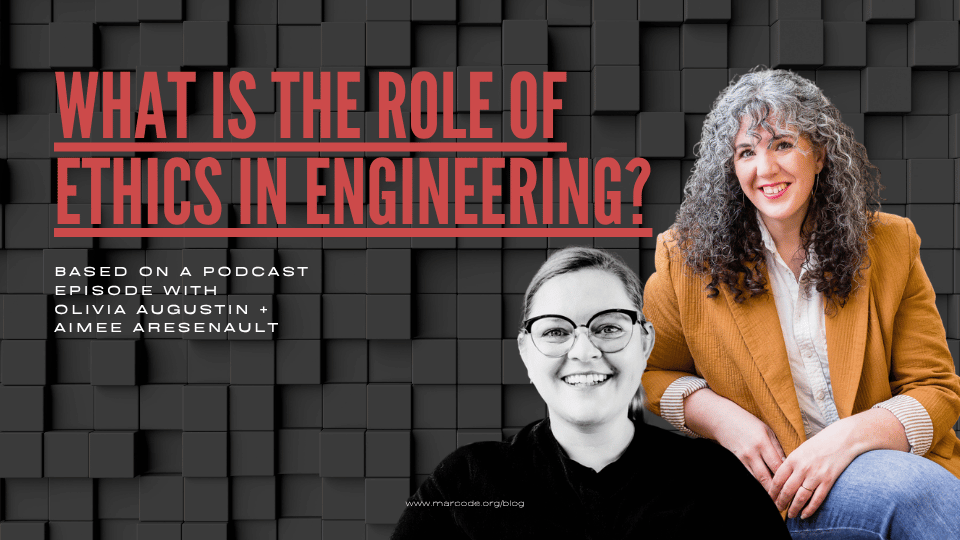
I recently chatted with Aimee Arsenault on my podcast English for Engineers. Aimee is a health and safety expert with a love of language and communications. She advocates for professionals to understand ethics so they can live by their values and improve the workplace. This episode was also a crossover with Aimee's own podcast, so if you enjoy it, go find her over there too.
Your moral compass helps you in situations as varied as saying no to a project and considering the thoughts and feelings of others in an organisation. This might not sound very engineer-y to you, but the importance of ethics in science and engineering affects the safety of other engineers, workers, and end users.
What Are Ethics In Engineering?
We often think of moral principles when discussing ethics. Memories from a philosophy class might come to mind — utilitarianism, individual rights, and duty — but these formulas are just the basis for acting ethically.
A code of ethics is often based on these principles and summarises how we apply them. In practice, this code can be difficult to act out. Definitions and morals can change from culture to culture, which is why it is important to understand your own interpretation and be able to explain it.
For example, if your code of ethics states you must act with integrity, what does that actually mean? Integrity most commonly means recognising your professional boundaries and competencies. You say no to projects outside your qualifications, training, and experience.
For Aimee, integrity came up when she was asked to create a confined space entry program. Although she had the education, she did not feel comfortable taking this project on. It went against one of her personal principles: not working in an environment where she would die if an alarm went off. Because of this, it would have been unethical for her to say yes.
For a different person, this situation might not have gone against their ethics — and that is exactly why this conversation is so important.
When you are able to communicate your reasoning, you can build trust and foster a culture of ethical behaviour in your workplace. Effective communication of your code of ethics can help everyone understand and respect the principles of the profession, leading to safer and healthier outcomes for all.
How To Apply Your Ethics In The Workplace
While you might understand your code of ethics, learning to communicate it effectively can be a necessary challenge. Once you understand your moral compass, you will be able to explain your design decisions, say no to projects, set a good example in the workplace, and be a force for good.
Here are some ways you can become a more ethical engineer.
Safety by design
When I was in engineering school, we calculated the number of casualties per kilometre for a tunnel design. Looking back, I find it shocking that we never discussed how to decrease these deaths.
You have an important role as an engineer to advocate for safety by design. Your work can lower casualties and improve the safety of not only the end user but the workers who build and maintain these structures.
Focus on safety from the very start of a project. How can you make the installation, maintenance, and end-user interaction as safe and easy as possible? You do not want people to wonder what the engineer was thinking when they designed something.
Feelings matter
Safety language differs from engineering language for a reason. Engineering documents are very much directorial, but when considering safety, we have to go beyond steps 1, 2, 3.
As much as we would like to think humans are logical, workers' different thoughts and feelings always come into play with safety. That is why safety documents consider emotions and why people do what they do.
Learn from how safety documents are written when designing or explaining something. Considering how others think, feel, and react will help you uphold your moral code.
Understand the why
If you are trying to get people to say yes to your proposal, you have to dig into why they are doing what they are doing. Learn to look for different terminology and manner of communication, especially in an international setting.
Sometimes, you might actually agree with someone, but your distinct communication style prevents you from realising it. Either way, figuring out the principles someone is coming from will help you reach a conclusion during a conflict.
Looking for practical strategies on this? Check out this article: Six Ways To Communicate In International Settings.
Remember, standards change
Have you seen the black-and-white photograph of the ironworkers sitting on a building beam without any safety equipment? Safety standards change. It is okay to be uncomfortable with protocols or to think a worksite should have stronger safety precautions. Most organisations will support your safety concerns if you can explain your reasoning clearly.
Safety standards often vary from company to company, and the language used to describe them can differ. Do not be afraid to ask for clarification when you arrive on a new worksite and to advocate for safer procedures. Even if English is your second language, take the time to listen to workers and stay up to date on new regulations and protections.
Culture is more important than language
Each interaction you have with someone affects the culture. You might know the work steps, but how you do them — and how you communicate what, how, and why you are doing them — should shift depending on who you are working with.
Your technical knowledge is only as useful as your ability to communicate it across cultures.
Dare to push back
As an engineer, you are considered an expert in what you do. Many people look up to you even if you are not in a managerial role. With this respect comes the responsibility to not only talk the talk but walk the walk. Use this authority to advocate for safety by design, speak up when you notice something dangerous, and learn how to say no without ostracising yourself.
And yes — saying no professionally, in a cross-cultural workplace, in a language that is not your first, without burning bridges? That is a skill. A very learnable one. But a skill nonetheless.
Frequently Asked Questions
Ethics in engineering guides how engineers make decisions, set professional boundaries, and communicate their values at work. It directly affects safety outcomes for end users, workers, and colleagues — and shapes the culture of every team an engineer is part of.
A code of ethics is a set of principles that guides professional behaviour. In engineering, this often includes integrity, competency, and responsibility for public safety. In practice, it means knowing your limits and being able to communicate them — including saying no to projects outside your qualifications.
Safety by design means building safety into a project from the very beginning, not as an afterthought. Engineers who prioritise this approach reduce casualties and protect the workers who build and maintain what they create.
Understanding your ethics is only half the work. Being able to communicate them clearly — across cultures, in meetings, in documents, and during conflict — is what makes them effective. This is especially relevant for engineers working in a second language or in international teams.
Yes. As an engineer, you are considered an expert in your field regardless of your seniority level. Most organisations will support a well-reasoned safety concern. The key is being able to explain your reasoning clearly and professionally.
Ready To Communicate Your Ethics With Confidence?
Knowing your values is one thing. Communicating them clearly in English — to colleagues, managers, and clients across different cultures — is another skill entirely.
English for Engineers is practical business English for non-native speakers, taught by an engineer who knows exactly what it is like to be in those rooms. Not grammar drills. Real communication skills for real engineering situations: saying no, pushing back, advocating for safety, and navigating international teams.
Book your free 15-minute call and we will find the right fit for you.

0 Comments