

If you’re an engineer who works internationally, you’ve probably run into this problem:
You understand your work. You know your process, your tools, your specs.
But the second you have to explain all that in English? Things slow down. You hesitate. You search for words. And then you second-guess every sentence.
And yet, most courses just teach you more grammar or more vocabulary, which still doesn’t help you explain what you do clearly and confidently.
That’s where Technical English for engineers comes in. But here’s the thing: there’s no single official definition of Technical English. Depending on who you ask — a linguist, an aerospace engineer, or a language teacher — you’ll get a completely different answer.
So before we talk about what it is, let’s talk about why it’s so confusing.
What “Technical English” Actually Covers (It Depends Who’s Talking)
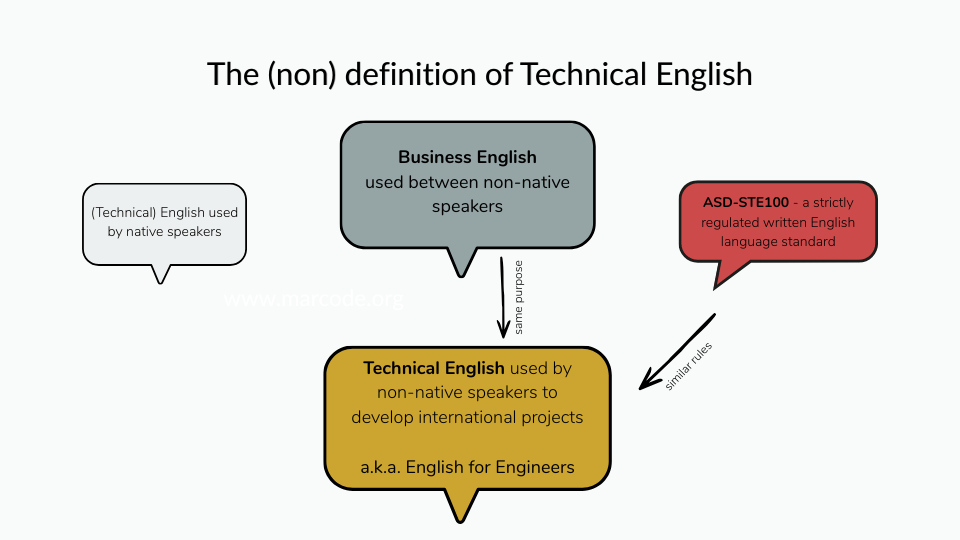
The term “Technical English” gets used in at least three different ways — and it helps to see where it sits among other types of English:
- Every English spoken by native speakers, including technical topics? Just called English.
- English used by non-native speakers — anywhere, anytime? Linguists call that ELF (English as a Lingua Franca). English teachers call it ESL — English as a Second Language — even if it’s your third or fourth.
- ASD-STE100 Simplified Technical English (STE)? That’s a strictly regulated written standard used in aerospace and defense documentation.
- Business English is a specialized subset of English focusing on professional communication, and Technical English for engineers sits inside that subcategory.
The English you learned at school? That’s Standard English. What engineers actually need for international projects is something more specific: Technical English as a subgroup of Business English, with rules borrowed from STE, adapted for spoken and written use in real projects. And as you'll see, there's more than one version of it.
That’s exactly why I’d prefer to call what I do English for Engineers, not Technical English. Because “Technical English” means something different to everyone.
What Is Technical English (Really)?
Spoiler: there’s no clean answer. Academics have been trying to define and categorize it for decades (see references below) — and they still don’t fully agree.
What most engineers assume it means: memorizing long lists of technical words from their field. A construction site manager’s vocabulary. An IT specialist’s jargon. Field-specific terminology.
That’s not it. I’m not a walking dictionary — and you don’t need to be either.
I was reminded of this recently in a conversation with Dr. Rachel Wolford, a colleague who helps US STEM researchers improve their academic writing to get published. She’s a native English speaker working with other native speakers. Her version of “Technical English” looks completely different from what my clients across Europe, Latin America, and Asia need to run international engineering projects.
Same term. Completely different thing.
STE: The Most Controlled Kind of Technical English
Ever heard of STE?
ASD-STE100 Simplified Technical English (STE) is a highly controlled version of English developed in the late 1970s by the European Association of Aerospace Industries (originally called AECMA Simplified English). It was created to help non-native English speakers write and understand technical manuals more easily and without confusion.
At first, it was used in commercial aviation. Later, it became a requirement in defense projects, including those involving land and sea vehicles. Today, many maintenance manuals are still written in STE.
In 2025, STE was upgraded from an international specification to a fully recognized international standard — a significant step for a language framework that started life as an internal aviation guide. The latest version, Issue 9, was published on January 15, 2025, and defines STE as follows:
ASD Simplified Technical English (STE) is an international standard for preparing technical documentation in a controlled language. STE has two parts: a set of writing rules (part 1) and a controlled dictionary (part 2). The writing rules are about grammar and style. The dictionary gives the general words that a writer can use.
As you can see, STE is a written language, not a spoken one. It simplifies complex grammar and vocabulary, replacing complicated terminology with clearer alternatives. This makes technical documents easier to read and understand — especially for non-native speakers.
From STE Rules to Real-Life Engineering English
STE was designed for written manuals with zero room for misinterpretation. The English you need for international projects is more flexible — but the underlying principle is the same: be understood. Always adapt to the person in front of you.
| STE Rule | English for Engineers |
|---|---|
| No phrasal verbs | Avoid them where possible — but if you’re certain the other person understands, use them. The goal is communication, not compliance. |
| 3 simple tenses only (past, present, future) | Start here — it covers the vast majority of workplace communication and is far less intimidating than the 12 tenses taught at school. As you progress, add present progressive and present perfect. These 5 tenses cover over 90% of what you need. But: only use them if your conversation partner understands them too. When in doubt, go back to the 3 simple tenses. |
| Max 20–25 words per sentence | Avoid compound sentences. Use bullet points and lists to break up complex information. Remember: in many languages, long sentences signal intelligence. In English, clarity does. As I always say: “Clear is kind.” |
| Avoid passive voice | The same rule applies, with nuance. If you can form it correctly and your audience is a native speaker, go ahead. If there’s any risk of confusion, especially with non-native colleagues, avoid it completely. |
| Use articles correctly (“a”, “the”) | Non-negotiable. Articles are one of the biggest sources of misunderstanding for non-native speakers. Get these right. |
| Sequential steps: use separate sentences or bullet points | Same guidance. Never string steps into one long sentence. |
Who Needs ASD-STE100 Simplified Technical English?
If you’ve never heard of STE before, chances are you don’t need to learn it. Regular Technical English — as a subgroup of Business English — is just fine for most engineers.
STE is mandated for written documentation in the aviation industry and the military. But its reach has grown. Today it’s also used across broader industry sectors, language services, and has even been adopted by universities and researchers worldwide.
That said, you don’t need to work in aerospace or defense to benefit from STE’s core principles. In any international project where teams need to avoid misunderstandings caused by language differences, the basic rules apply: short sentences, no ambiguity, clear structure.
What STE doesn’t cover? Speaking. And that’s where most engineers struggle the most. Whether it’s a stakeholder meeting, an international call, or explaining a technical problem to a colleague, engineers worldwide need to communicate clearly and concisely in both writing and speech.
So the next time someone tells you they teach “Technical English,” ... ask them what they really mean. That’s exactly why I’d prefer to call what I do English for Engineers.
Want to hear more about how engineers use Technical English in real projects? I talk about this in the English for Engineers podcast — available on all major platforms.
Understanding technical concepts was never your problem. Explaining them in English is.
You know your stuff. You’ve got the experience, the qualifications, the engineering brain. But somewhere between your thoughts and the English words that come out — things get lost.
And no, the solution is not more grammar worksheets. (You’ve suffered enough of those.)
The Technical English Group Course is a practical, no-fluff program built by an engineer — yes, an actual engineer — to help you:
- Stop translating in your head and just talk
- Explain technical details so clients and colleagues actually get it
- Show up to international meetings as the expert you already are
Your English should reflect your engineering skills. Let’s make that happen.
→ Join the Technical English Group Course
FAQs
No — and that’s exactly what makes it confusing. Unlike ASD-STE100 Simplified Technical English, which is a formal international standard, “Technical English” as a general term has no single official definition. It means different things to linguists, language teachers, and engineers. What matters for non-native speaking engineers is a practical subset of Business English: clear, concise, and adapted for international projects.
Business English covers all professional communication in English — emails, meetings, negotiations, presentations. Technical English for engineers is a subcategory of Business English, focused on clearly communicating complex technical information across language barriers. Think of Business English as the umbrella, and Technical English as the engineering-specific tool underneath it.
Almost certainly not. Engineers in aviation or defense have to use STE. But for most engineers working on international projects, the principles behind STE — short sentences, no ambiguity, active voice — are useful, but you don’t need to follow the full standard. Regular Technical English, as a subgroup of Business English, is enough.
ESL (English as a Second Language) is the term English teachers use for any English learned or used by non-native speakers — whether it’s your second, third, or fourth language. ELF (English as a Lingua Franca) is the linguistic term for English used as a common language between people who don’t share a native language. Most international engineering communication is technically ELF — but ESL is the term you’ll hear most in language education.
Because most English training isn’t built for engineers. Standard ESL courses teach general communication — and far too much grammar you’re not even supposed to use in Business English. Not how to explain a technical process to a stakeholder, run an international project meeting, or write a clear incident report. High-level engineers often have solid grammar but lack the specific communication tools their work demands. That’s the gap Technical English (and English for Engineers) is closing.
References
Baker, M. (1988). Sub-technical vocabulary and the ESP teacher: An analysis of some rhetorical items in medical journal articles. Reading in a Foreign Language, 4(2), 91–105.
Bonamy, D. (2008). Technical English 1. Harlow: Pearson.
Cowan, J.R. (1974). Lexical and syntactic research for the design of EFL reading materials. TESOL Quarterly, 8(4), 389–400.
Farrell, P. (1990). Vocabulary in ESP: A lexical analysis of the English of electronics and a study of semi-technical vocabulary. CLCS Occasional Paper No. 25. Trinity College.
Fraser, S. (2006). The nature and role of specialized vocabulary: What do ESP teachers and learners need to know? Hiroshima Studies in Language and Language Education, 9, 63–75.
Hollett, V., and Sydes, J. (2009). Tech Talk Intermediate Student’s Book. Oxford: Oxford University Press.
Nation, P. (2001). Learning Vocabulary in Another Language. Cambridge: Cambridge University Press.


0 Comments