

Estimated reading time: 6 minutes
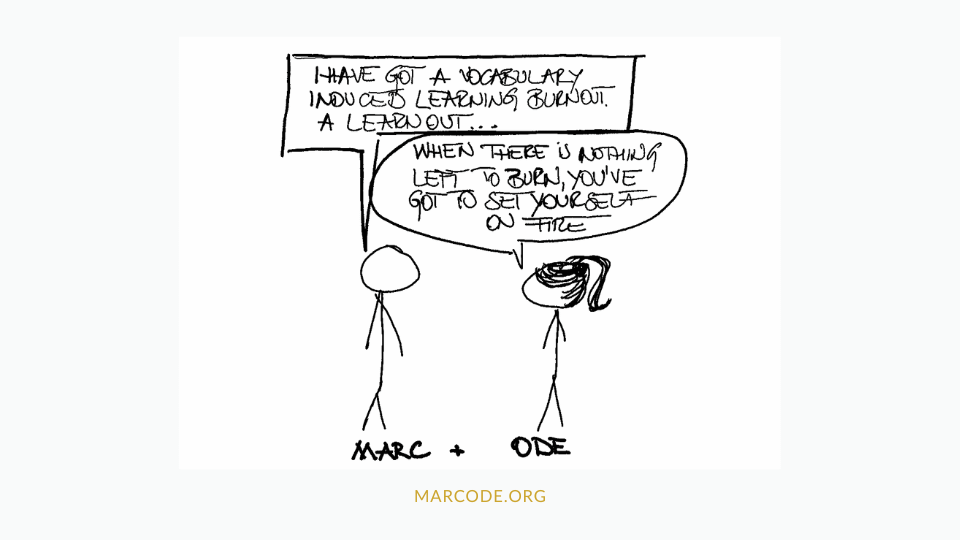
5 ways to avoid vocabulary-learning burnout. Or as I like to call it: a learn-out.
A lot of engineers tell me the same thing: learning new technical vocabulary in English is boring, frustrating, and somehow never sticks. And I get it. Memorizing word lists is about as effective as reading a maintenance manual and hoping the machine fixes itself.
The good news: there are smarter ways to do this. Here are five.
Start Using New Words the Same Day You Learn Them
This is the single most effective thing you can do. Not tomorrow. Not after you've seen the word a few more times. The same day.
Here's why: research by vocabulary acquisition expert Paul Nation shows we need to encounter a word up to 17 times before it moves into passive knowledge — the place where we recognize it when we hear it. Active use takes even longer. Every time you use a word in a real sentence, you're accelerating that process.¹
So when you learn a new term, don't just highlight it. Use it. Write a sentence with it. Say it out loud. Use it in your next meeting. Tell your partner about it over dinner. It doesn't have to be perfect. It just has to happen.
Quick example: learned "commissioning" today? Don't file it away. Say it: "We're in the commissioning phase" — even if just to yourself on the way to the coffee machine.
That counts. Your brain doesn't care if anyone heard you.
(I have a whole podcast episode coming on self-talk as a practice tool — link coming soon.)
Cover Your Workspace in Sticky Notes (Yes, Really)
Those small yellow pieces of paper with the re-adherable strip of glue? Worth gold.
Use them as wallpaper. Your office, your home, your everything should be plastered with new vocabulary. Stick a term on your monitor. Another one on the coffee machine. One on the bathroom mirror if you're serious about this.
The logic is simple: repeated visual exposure is one of the easiest ways to rack up those 17 encounters without sitting down to "study," without downloading another app, creating an account, choosing a password, and then completely forgetting it exists.
Ugly? Yes. Working? Also yes.
A Lot of Technical Terms Are More Logical Than They Look
Engineers are pattern recognition machines. Use that.
Before you try to memorize a technical term, look at its parts. What do the individual words mean? What's the root? Often the meaning is hiding in plain sight.
A few examples:
- "Slash hammer" — what does "to slash" mean? Now the tool makes sense.
- "Overpressure" — over + pressure. Done.
- "Load-bearing" — bearing a load. You already knew this.
This works especially well in English because a huge chunk of technical vocabulary is built from Latin and Greek roots that repeat across dozens of terms. Spot one root, unlock ten words.
It won't work every time. But when it does, you won't need the sticky note.
Explain New Words to Someone Else
This one pulls double duty.
When you explain a new term to someone, you're doing two things at once: actively using the vocabulary (see Tip 1) and breaking down the word structure to make it stick (see Tip 3). You're essentially combining two techniques without extra effort.
And you don't need a willing student. Explain it to a colleague who might actually use it. Mention it to your partner over dinner — again. Corner a friend. It doesn't matter who. The act of explaining forces your brain to retrieve and reconstruct the word, which is exactly the kind of effort that builds long-term retention.
Bonus: if you can explain a technical term clearly in English to someone who doesn't know it, you've genuinely learned it. That's a pretty solid test.
Win-win.
Try Semantic Mapping
Semantic mapping is a vocabulary learning technique where you build a visual diagram around a new word.
You put the target word in the centre and branch out from it: synonyms, antonyms, related terms, an example sentence, the context where you'd use it. Think mind map, but specifically for vocabulary.
Why it works: instead of learning a word in isolation, you're building a web of connections around it. And the more connections a word has in your brain, the easier it is to retrieve when you actually need it.
It sounds like extra work. It isn't. One semantic map takes about five minutes and covers more ground than a page of definitions. And honestly — you're an engineer. Drawing up schematics is second nature. This is just a schematic for a word.
You might wanna google some templates to get started. Or call me.
So — How Many Were New?
How many of these are you already doing? And how many were completely new?
Either way — knowing the techniques is step one. Actually using them is step two. And that's where most engineers get stuck. Not because they're not trying, but because there's no one in the room giving them feedback on whether it's working.
That's exactly what The 25 Minutes is for. One-on-one conversational training, 25 minutes, built around your schedule. You practice speaking, you get direct feedback, and you leave with something concrete to work on.
If that sounds useful, get in touch. We'll find a time that works.
FAQ: Vocabulary Learning for Engineers
Research suggests we need to encounter a word up to 17 times before it enters passive knowledge — the point where we recognize it reliably. Active use takes longer. The fastest way to speed up that process is to use the word immediately and repeatedly in real contexts, not just read it on a list.
Use it the same day you learn it. Passive methods like highlighting or re-reading have limited impact. Speaking, writing, and explaining new terms to others are consistently more effective for long-term retention.
Semantic mapping is a technique where you build a visual diagram around a new word — connecting it to synonyms, related terms, example sentences, and contexts. It works because the more connections a word has in your memory, the easier it is to retrieve under pressure.
Usually not because of a lack of effort. Most engineers learn vocabulary in isolation — word lists, definitions, flashcards — without enough real-world practice. The gap is between knowing a word and being able to use it naturally in a meeting or a report.
Sticky notes, self-talk, and explaining terms to others require almost no dedicated study time. If you want structured practice with direct feedback, short focused sessions like The 25 Minutes are designed specifically for engineers with busy schedules.
¹ Nation, P. (2001). Learning Vocabulary in Another Language. Cambridge: Cambridge University Press.



0 Comments