

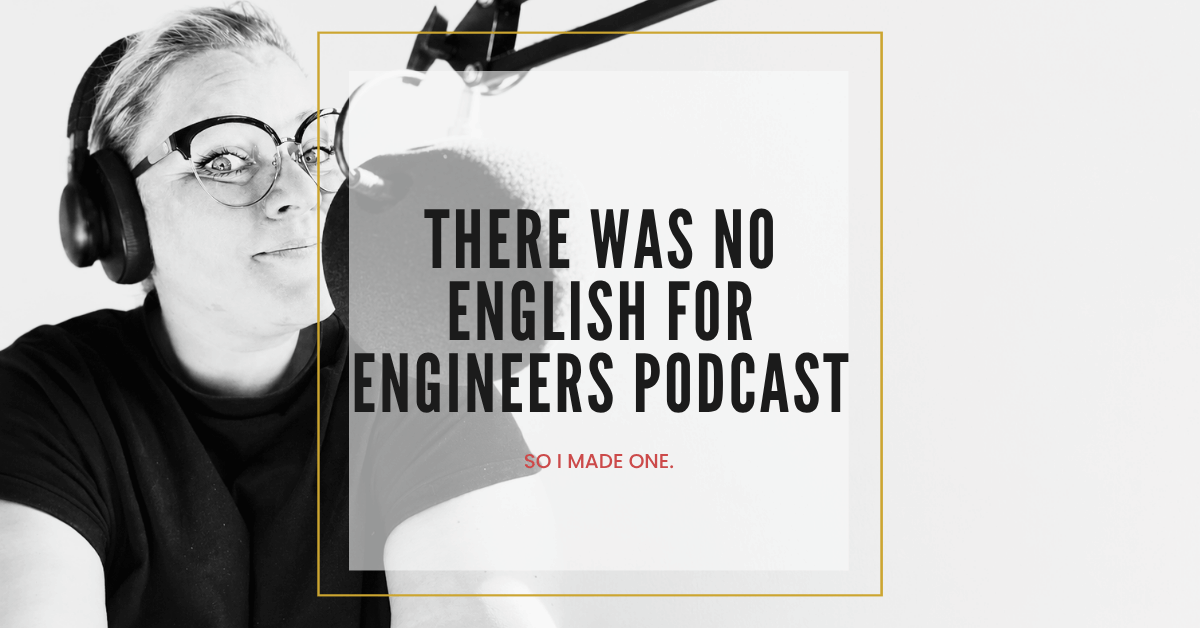
Back in 2021, one of my engineers spotted a fancy microphone in the background during an online lesson. "Do you sing in your free time?" he asked.
I do not. I mean, I sing. Who doesn't? But I don't record myself and then sit there listening to my own audio. That would be weird.
I told him I'd just recorded my first podcast episode. His next question stopped me in my tracks: "Why?"
Not "cool!" Not "what's it about?" Just: "Why?"
I asked him what he meant. He clarified: "Why do you make a podcast? Is it for fun, or is it marketing?"
Good question, innit? Kind of both. But the real answer is longer than that. And it starts with a problem my clients kept running into.
I Told Them to Listen to Podcasts. Then They Couldn't Find One.
For years, I've been telling my clients the same thing: high-quality input produces high-quality output.
What does that mean in practice? If you want to improve your spoken and written English, you need to consume English. Read it. Listen to it. Regularly. And because most of my clients are engineers who spend half their lives driving between project sites, podcasts made perfect sense. You can listen while driving to work, or from one project site to another, while working out, or while pretending to pay attention in a meeting. (I didn't say that last one.)
Whenever my clients listened to me (and unfortunately, not all did nor do), they came back a few weeks later and said they couldn't find the right one.
Engineering podcasts? Plenty — by the dozen, in fact. (That's an idiom: "by the dozen" means "a lot".) But the hosts were native English speakers talking at full speed, and after a long day on site, that's not relaxing. That's a second job.
Business communication podcasts? Too generic. Nothing to do with engineering, construction, or technical work.
English grammar podcasts? Those gave them almost PTSD-worthy flashbacks to their high school days.
So there I was, telling engineers that listening to a podcast in English was one of the best things they could do for their fluency. While quietly realising that the perfect podcast for them didn't exist. Yet.
So I Became the Solution
When one cannot find a solution, one must become the solution. (Imagine me saying that with a VERY British accent.)
My engineers needed a podcast that actually worked for them. Not just something to fill the silence on the motorway, but something that would genuinely move the needle on their English. Here is what that list looked like:
A podcast for engineers, by an engineer. One that covers Business English and the realities of working in international teams. That explains Technical English without dumbing it down. That introduces new vocabulary in context, so it actually sticks. That is long enough to be useful, but short enough to keep your attention after a full day on site. That is interesting enough to make you want to press play again next week.
And — because engineers are, let's be honest, a very specific kind of human — something a little geeky. Something that does not take itself too seriously.
That is what the English for Engineers podcast is.
It is not a grammar lecture. It is not a corporate communication seminar dressed up as entertainment. It is a podcast made by someone who has stood on construction sites, read technical drawings, and also spent years helping engineers find the right words in the right language.
So, to answer the initial question: why do I make a podcast? Because of you. (And because it is fun.)
And then this happened: two listeners from two different countries — both department heads at universities — listened to the podcast and invited me to give guest lectures at their respective institutes. I did not see that coming.
Over 7,000 engineers now follow the show on Spotify, with around 100 new listeners joining every month. Episode #001 has been listened to 8,200 times in the last three months alone (2nd quarter of 2026). Not bad for a podcast that started because my clients couldn't find one that worked for them.
What to Expect When You Press Play
Every episode is designed to give you something useful. Not useful in a "sit down and study" way. Useful in a "I learned something without realising it" way.
Some episodes are solo, some feature guests. Either way, you will find practical tips on language learning that actually fit into a working engineer's schedule. Interviews with guests from construction, engineering, and technical industries around the world, so you get used to different accents and different ways of thinking. Deep dives into engineering culture, international teamwork, and what happens when language barriers meet tight deadlines. And the occasional conversation about Business English and Technical English, explained in context.
Episodes run between 10 and 40 minutes. Short enough for a commute. Long enough to actually cover something worth covering.
The goal is always the same: interesting input that makes your English better without feeling like homework.
Do I aim high? Yes. Will every episode win an award? Probably not. But I will show up, keep it real, and make sure you walk away with something you can actually use.
Where to Start
If you are new here, I recommend starting with episode #001 — "Well, Hello There Engineers." It is 11 minutes long, which means you can finish it before your coffee gets cold. I introduce myself, tell you a bit about my background in engineering, and share four language learning tips you can start using straight away — no course required, no subscription, no catching up to do.
You can find the English for Engineers podcast on Spotify and Apple Podcasts.
Listen to episode #001 on Spotify →
And if you want to know whether working with me one-on-one is the right next step, you are welcome to book a free 15-minute discovery call at marcode.org/contact. No pressure, no sales pitch — just a conversation.
FAQ
When the right guest comes along or I have a brainfart. (That is an informal way of saying "a sudden idea", by the way.) I do not publish episodes just for the sake of filling a release schedule. Every episode goes out because I genuinely think it is worth your time. Which means sometimes you wait a little longer — but you never get filler content. Or as Star Trek's Captain Janeway would say: "I don't care how it looks, I care about what's right."
Got a topic you want me to cover? A funny, interesting, or teachable moment from your own experience working in English that I can share with listeners? Send it to info@marcode.org. If I like it, I might mention it in a future episode — anonymously, or with your first name if you are happy with that. I read every email.
Yes — and you have found it. The English for Engineers podcast covers Technical English, Business English, international project communication, and engineering culture. It is made by a civil engineer and certified English teacher, for engineers. Episode #001 is the best place to start.
The podcast works best if you are around B2 level on the CEFR scale (Upper-Intermediate) — meaning you can follow conversations in English but still want to sharpen your professional communication. That said, motivated B1 listeners tune in too, especially for the shorter solo episodes.
You can find it on Spotify and Apple Podcasts. Search "English for Engineers" — it is exactly what engineers type into the search bar, which is either very clever or very obvious. Possibly both.
Original Post from 15 December 2021; latest update: 15 December 2025.
0 Comments