

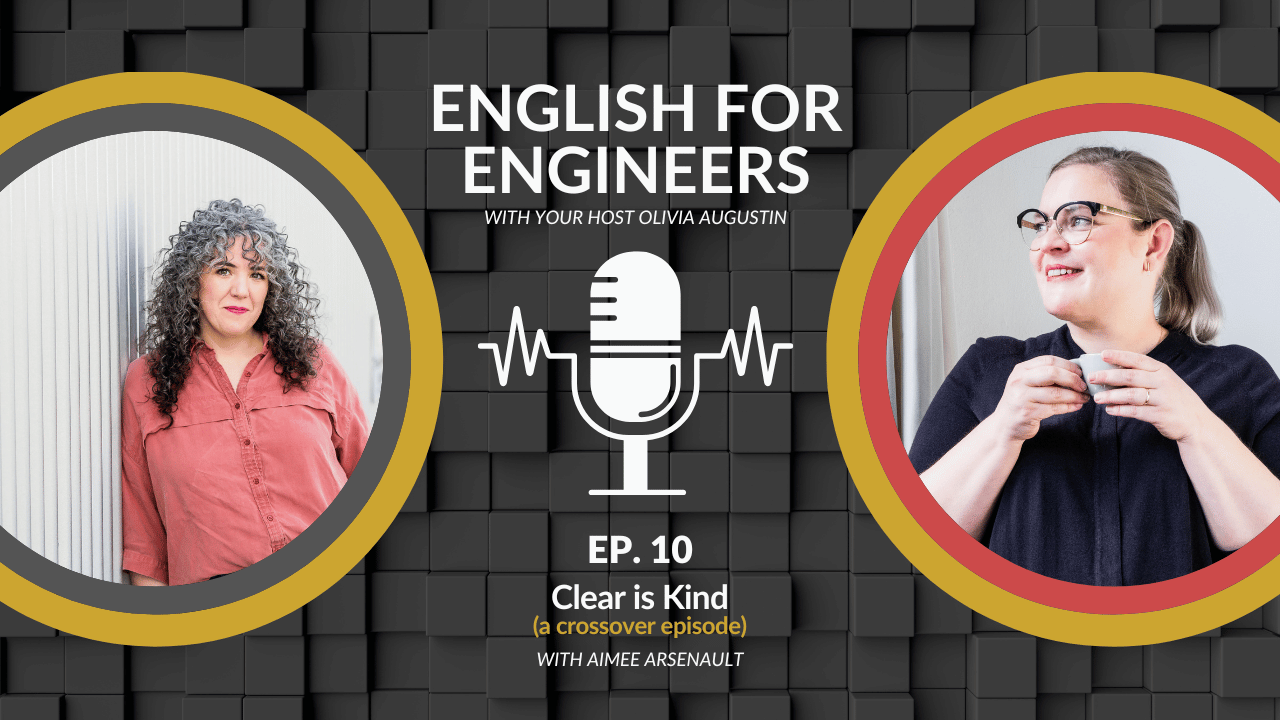
Engineers are trained to communicate in steps. Step 1, step 2, step 3. Read the diagram, follow the procedure, done. But the moment a project manager asks you to cut a 4-hour safety orientation down to 20 minutes, or a client asks you to sign off on something outside your competency, "step 3" doesn't help you say no.
That's exactly the gap this episode fills — a crossover episode with Aimee Arsenault, founder of Transmit Safety, a boutique health and safety consulting firm out of Edmonton, Alberta. Underneath every code of ethics is a skill nobody teaches directly: saying what you mean, clearly, without losing the relationship.
What You'll Learn in This Episode
For Aimee, it meant turning down a paying client. She'd let her own confined-space ticket lapse on purpose, years earlier, because she'd made a career decision never to work somewhere a single alarm could mean her life. When a client asked her to build a confined-space entry program, she didn't feel competent to write it — so she said no, even though she technically could have taken the work.
The harder test isn't the big ethical line — it's the small daily pressure, like a project manager asking to compress a 4-hour orientation into 20 minutes because a worker's needed in the field now. Aimee's answer is still no, but she holds it the same way every time. Give in once, and the line moves further next time. Hold it consistently, and you stay "part of the solution" instead of "the difficult one."
Engineering documents are directive: step 1, step 2, step 3, read this diagram. Safety documentation often has to do more — it accounts for how a worker feels walking into a training, what they're thinking at a certain point in a procedure, how content will land emotionally with the room. Neither is wrong; they're built for different jobs.
Aimee has taken the identical procedure from one project site to another, inside the same organization, and watched the work steps stay the same while word choice, tone, and what's sayable in the lunchroom changed completely. Region, project, and even who's making the coffee that morning shape communication style.
Sit back, listen to understand, and observe before you act. Watch who people look at in a meeting when someone speaks, and who nods first. Authority in a room isn't always the person at the top of the org chart — it's often whoever has built "referent power," trust earned through respect rather than title.
It's easy to design a product, building, or piece of equipment for the end user and stop there. Aimee's challenge: also design for the person installing it and the person maintaining it — the technician who has to physically contort into an awkward position to service something nobody thought through at the drawing stage.
The English for Engineers podcast is here to help engineers and technicians from all backgrounds improve their communication skills and provide them with interesting facts so that Technical and Business English becomes their new superpower.
Sound familiar? Here's how the whole conversation went.
Meet Aimee Arsenault
Aimee's path into health and safety started with a cultural anthropology degree, a year living in Germany, and a detour through a company's accounting department before she talked her way into a health and safety administration role. That anthropology background shows up everywhere in how she works: she treats every jobsite like a culture to be observed before it's a set of rules to be enforced. She holds CRSP and CHSC designations, and has spent years consulting across the construction industry, where she's seen firsthand how much workplace communication shapes safety outcomes.
How to Say No Without Burning the Bridge
Every professional designation Aimee holds comes with a code of ethics attached. Signing it isn't the hard part — living inside it is. She shares the real test: a client once asked her to build a confined-space entry program. She'd let her own confined-space ticket lapse on purpose, years earlier, because she'd made a career decision never to work somewhere that a single alarm could mean her life. She didn't feel competent to write that program, so she turned the work away.
That's the easy version. The harder version is a project manager pushing to compress a 4-hour orientation into 20 minutes because a worker is needed in the field now. Aimee's answer is still no — but how she says it matters as much as the no itself. Give in once, she points out, and the line moves a little further next time, and the time after that. Hold it every time, and you're "the difficult one." The skill is holding the line while still being seen as part of the solution.
(We go deeper on where that code of ethics itself comes from and how engineers can build their own in The Role of Ethics in Engineering — this episode picks up right where that one leaves off.)
Engineering Language vs. Safety Language
One of the more useful distinctions Aimee draws: engineering documents tend to be directive — step 1, step 2, step 3, read this diagram. Safety documentation often has to do more. It has to account for how a worker feels walking into a training session, what they're thinking about when they hit a certain point in a procedure, how a piece of meeting content is going to land emotionally with the room. Neither is wrong. They're built for different jobs. But an engineer who only knows how to write instructions will struggle the moment they need to change a behavior instead of just describing a step.
Why the Same Company Can Sound Like Two Different Companies
Aimee has taken the identical procedure from one project site to another, inside the same organization, and found the work steps stayed the same while everything about how people talked about them changed — word choice, tone, what could be said in the lunchroom versus what couldn't. Region, project, and even who's making the coffee that morning all shape it.
(This is a topic we've unpacked in full over on 6 Ways to Communicate in International Settings — worth a read if this is the part that's sticking with you.)
Starting a New Job? Watch Before You Speak
Aimee's number one tip for anyone walking into a new organization, new team, or new country: sit back, listen to understand, and observe before you act. Watch who people look at in a meeting when someone speaks. Watch who nods first, and who nods after them. Authority in a room isn't always the person at the top of the org chart — it's often whoever has built what Aimee calls "referent power," trust earned through respect rather than title. Reading that correctly, before you open your mouth, tells you far more about how to operate than the org chart ever will.
Safety by Design: Think Past the End User
A design detail worth sitting with: when engineers design a product, a building, or a piece of equipment, it's easy to design for the end user and stop there. Aimee's challenge is to also design for the person installing it and the person maintaining it — the technician who has to physically get their body into an awkward position to service something nobody thought through at the drawing stage. Safety by design means thinking about all three: install, maintain, use.
Key Takeaways
- A code of ethics only works if you can communicate it — knowing your line isn't the same as being able to hold it out loud.
- Saying no doesn't have to cost you the relationship, but saying yes when you shouldn't will eventually cost you more.
- Engineering language instructs. Safety language often also has to account for emotion — know which one the moment calls for.
- Communication style shifts by region, by project, even within the same company — pay attention to the room, not just the org chart.
- When starting somewhere new: observe first. Referent power tells you more than a title does.
- Design for the installer and the maintenance technician, not just the end user.
Listen to the Rest of the Conversation
This is only half the story. Aimee and Olivia recorded a longer conversation, and the second half is live on Aimee's own show, Transmit Safety — including the story of how the two of them met in the first place. Find it on Spotify or wherever you listen to podcasts.
CONNECT WITH AIMEE ARSENAULT
Aimee Arsenault is a CRSP and CHSC. She is the founder of Transmit Safety, a business that helps you simplify and streamline health & safety management systems.
LinkedIn: Aimee Arsenault | Instagram: @transmit.safety | Twitter: @transmitsafety | Website: transmitsafety.com
CONNECT WITH OLIVIA AUGUSTIN
Olivia Augustin is a civil engineer and certified English as a second language teacher. With her one-on-one lessons and group courses, she teaches non-native English-speaking engineers the kind of English that gets the job done.
0 Comments