

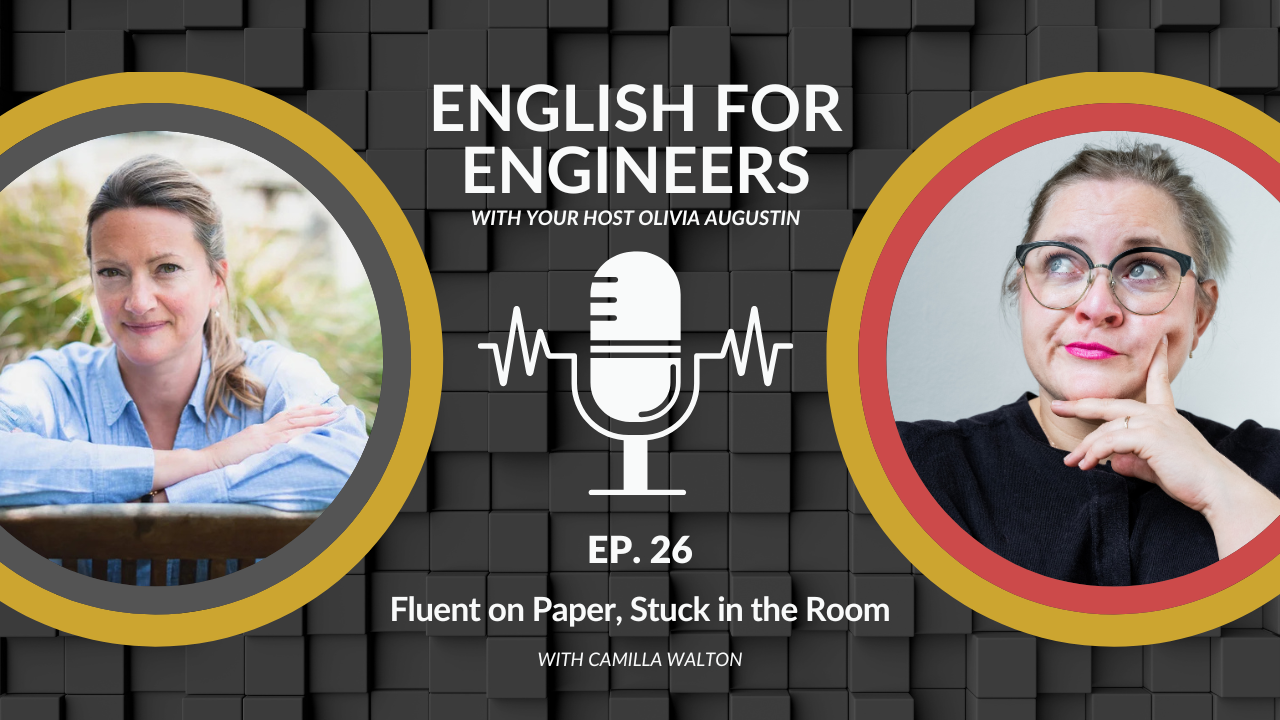
A few weeks ago I was scrolling through LinkedIn and came across a post that stopped me. Not because it said something new but because someone had written down something I say to engineers every single week, almost word for word. The only difference? This person coaches landscape architects and garden designers.
Her name is Camilla Walton. She's the founder of Cultivate English, a trained garden designer herself, and an English communication coach for international designers working in English. So I reached out. In this episode, Camilla and I talk about why so many technicians are freezing up when speaking English, and dig into something we've both noticed across very different industries: the gap between knowing English and being able to use it when it actually counts.
What You'll Learn in This Episode
Under pressure, the brain hits a bandwidth limit — Camilla compares it to a home wifi network with too many devices streaming at once. When you're speaking a language you're not fully comfortable in, in a high-stakes moment, the vocabulary you already have becomes hard to retrieve. It's not missing — it's frozen. People experience this as a vocabulary gap because "confidence" and "fluency" are the words available to describe it, but the real problem is performing under pressure, not knowledge.
A general English teacher works from course books and teaches to a CEFR level — B2, C1 — regardless of what the student does for a living. A niche coach builds materials around your actual world: for Camilla's clients, that means diagnostic concept presentations, industry-specific vocabulary, and — depending on what's really getting in the way for that person — targeted pronunciation work or confidence coaching. Every lesson is custom-built for the job and the person, not a one-size-fits-all course.
It's two languages in one, as Camilla and Olivia put it: the peer-to-peer language engineers and designers use with each other, and the client-facing language needed to sell and defend an idea to someone who isn't technical. On top of that sits a third layer — diplomatic language, for pushing back or saying no without damaging the relationship. None of that comes from a course book.
AI is genuinely useful for writing — drafting emails, summarizing documents, speeding up first drafts. But oral communication under pressure is a different skill entirely. When a stakeholder asks an unexpected question on site, there's no tool to consult in the moment. And using AI output well requires the very skill you're trying to build: English good enough to catch it when the output is wrong. That trust in yourself only comes from real practice.
Camilla shared something she'd heard just before this recording: a designer who, after spending hours on a landscape design, handed the job of presenting it over to a colleague with stronger English rather than risk freezing under pressure. Camilla's reaction: that person still wants to sell their own design, still wants to be recognized professionally, still wants ownership of it — and someone else standing in that room can't actually explain the thinking behind every decision the way the designer can.
Resources mentioned:
Resources and Links
For more on communicating across cultures on site: 6 Ways To Communicate In International Settings
Camilla's Freedom to Communicate programme: cultivate-english.com/freedom-to-communicate
Get on the waitlist for Olivia's next Technical English Group Course
For more on the confidence side of this gap: Why Engineers Sound Less Confident in English Than They Are
Connect with Camilla Walton
Camilla Walton is an English communication coach for international landscape architects and garden designers, and the founder of Cultivate English. She helps designers close the gap between what they know and how it sounds in English.
LinkedIn | Website | Freedom to Communicate programme
Connect with Olivia Augustin
Olivia Augustin is a civil engineer and certified English as a 2nd language and Business English teacher. With her one-on-one lessons and group courses, she teaches non-native English-speaking engineers the kind of English that gets the job done.
Contact me | Get the newsletter | LinkedIn | Instagram
0 Comments