

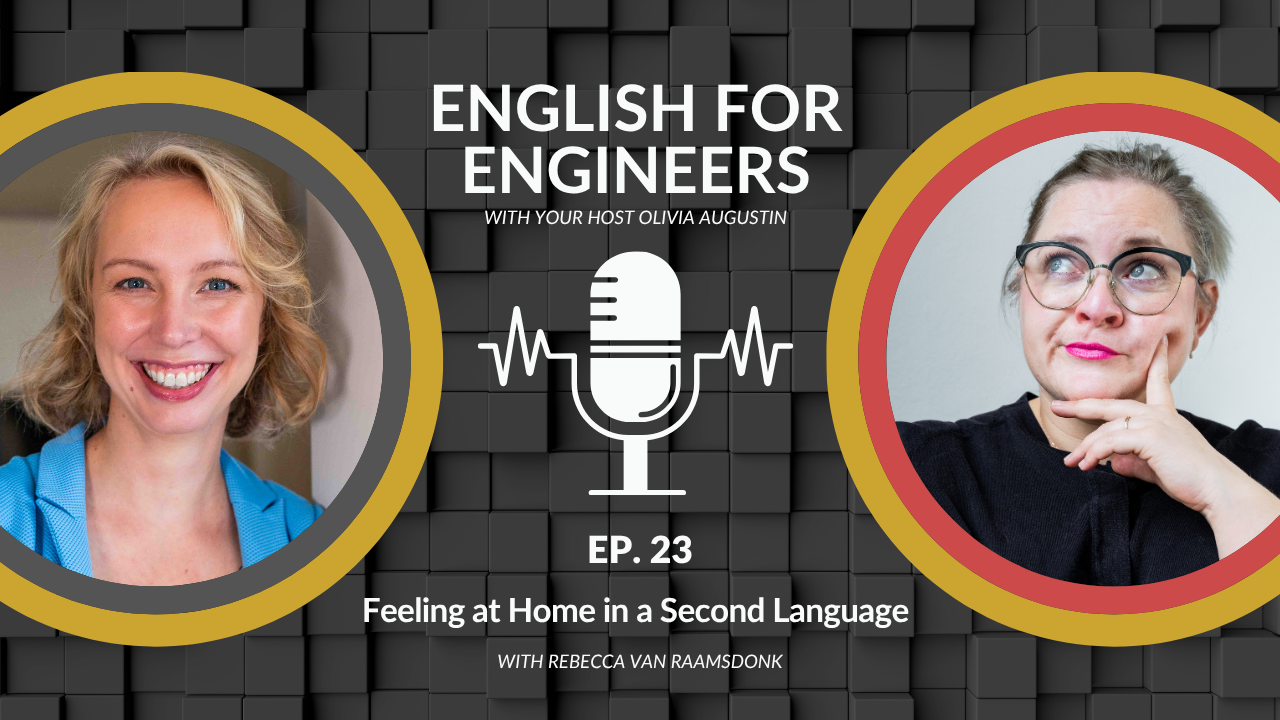
Why does a Dutch teacher turn up on a podcast about English for engineers? Because the problem does not change with the language.
Rebecca van Raamsdonk founded Nabu Academy, a Dutch-language school for advanced learners at the B2 and C1 levels. Olivia teaches engineers at roughly the same level in English. Both keep meeting the same student: someone who knows the grammar and the vocabulary, and still says almost nothing at a business function.
Rebecca calls the goal feeling at home in a second language. It is the phrase on her own website, and it describes something grammar drills never reach.
In this conversation, the two teachers compare methods. They agree on more than they expected. No textbooks. No word lists. No fixed curriculum. Students pick the topics, vocabulary comes out of real conversation, and corrections happen without breaking anyone's flow.
They also take apart some assumptions that hold advanced learners back. Knowing more does not make you confident. Feeling calm is not the same as being confident, and speaking is not a test you have to pass again with every sentence.
Olivia adds the engineering angle. Engineers are trained perfectionists, because a calculation is either right or the structure falls down. Language does not work that way, and that mismatch is where a lot of engineers get stuck.
What you'll learn in this episode
It means using the language without treating every sentence as an exam. Rebecca van Raamsdonk uses the phrase for the point where a language stops being a subject you study and becomes part of your daily life. You still make mistakes. You just stop bracing for them.
The knowledge sits in your head. It does not travel to your mouth. There is a barrier between the two, and it comes from fear of judgement as often as from any gap in your language. Advanced students hold long conversations in class, then say the bare minimum at a party or business meeting.
Probably not. Some students speak almost perfectly and still feel they cannot do it. Others at a lower level chat happily with everyone and do not mind their mistakes. The two things are not connected, which is why more study rarely fixes a confidence problem.
Yes. You can feel the stress and speak anyway. Confidence is not the absence of fear, and it is not something you are born with. You build it by doing the thing, the same way you would face an important call or a job interview in any language.
Speak, repeatedly, about the things you actually need to discuss at work. Olivia describes confidence as a muscle you train. Engineers carry a habit of perfectionism from technical work, where a calculation is right or it is wrong. Language has no equivalent, so your standard has to change first.
Yes, and they beat films and the news for this. An unedited podcast keeps the hesitations, restarts and self-corrections in, because that is how people actually speak. Olivia invites guests for a related reason: engineers need practice understanding many different accents.
RESOURCES AND LINKS
- Free English Learning Resources: Olivia’s Freebies for Engineers
- Technical English Group Course: for engineers ready to lead meetings, explain designs, and stop second-guessing their words.
- Emails for Engineers Template Pack: real emails you can copy and paste into your next update or request.
- Free Dutch Resource (Rebecca): Masterclass: From Insecure to Fluent (B2/C1 Dutch)
- We Have a Saying: Why Your Own Expressions Belong in English Too
- Why Engineers Sound Less Confident in English Than They Are
- Fluent on Paper, Stuck in the Room
- You Don't Have to Master Everything Yourself
Connect with Olivia Augustin
Olivia Augustin is a civil engineer and certified English as a 2nd language and Business English teacher. With her one-on-one lessons and group courses, she teaches non-native English-speaking engineers the kind of English that gets the job done.
Contact me | Get the newsletter | LinkedIn | Instagram
Connect with Rebecca van Raamsdonk
Founder of Nabu Academy: Dutch for advanced learners (B2–C1).
0 Comments