

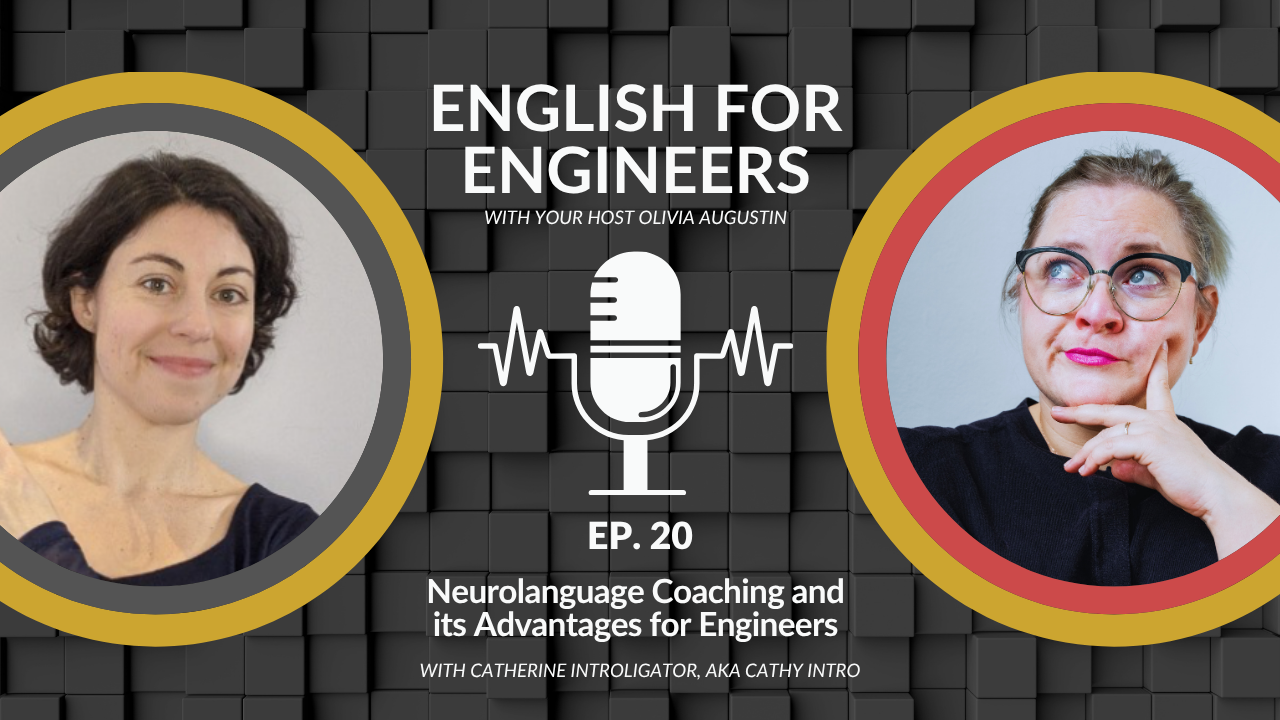
Neurolanguage coaching blends neuroscience, language expertise and coaching into one approach. Olivia had seen the term on LinkedIn for months. She had never had time to look it up. So she invited a certified coach onto the show.
Cathy Intro is an entrepreneur and a certified Neurolanguage Coach in Montreal, Quebec. She trains the next generation of coaches. She also hosts My Polyglot Life en français for upper-intermediate and advanced French learners.
Halfway through the conversation, Olivia recognised her own teaching in Cathy's description. She had worked this way with engineers for five years, without a name for it. This episode gives that approach its name, and shows what it looks like in an engineering context.
What You'll Learn in This Episode
The name explains the three parts. "Neuro" stands for neuroscience and knowledge about the brain. "Language" stands for the coach's language expertise. "Coaching" describes how the work runs. You set goals, build an action plan, review your progress and adjust. More than 1,500 certified coaches now work in around 70 countries. Olivia is not certified in the method. She arrived at many of the same practices on her own, which is where this conversation gets interesting.
Traditional teaching is vertical. The teacher stands above the learner. Coaching is horizontal. Cathy and her client are partners in one project, and that project is your language. Olivia works the same way with engineers. Grown adults already know what they need, so she asks first and prescribes second. Her stated goal is to make you independent of her. She wants you to understand the underlying system, not memorise every detail. She often opens a lesson by saying you do not have to remember this. That single sentence relaxes people, and they listen more closely as a result.
Some clients say they are paying for the expertise, so the coach should decide. Cathy takes that role when asked. She also explains why self-assessment gets you there faster. Olivia sees the same pattern. New students often arrive convinced their English is far worse than it is. After two or three lessons, the picture changes and so does the dynamic.
You set indicators at the start. Cathy calls them KPIs. You rate your own fluency and vocabulary, often on a scale of one to ten. Olivia avoids tests and marked homework for a simple reason: neither resembles your actual working life. She measures in numbers, in time, or in how confident you feel. Real-life signals count too. Your colleagues stop switching to your shared language. Nobody asks whether you understood.
Olivia's clients often tell her they feel like a baby when they speak English. Months later, the same people describe feeling confident in a meeting. That shift changes how the room treats them. Colleagues start hearing the engineer rather than the accent. Cathy makes the same point from the coaching side. People forgive a great deal of imperfect grammar when they can tell you are genuinely interested in them.
Engineers want to know how things work. And language becomes another system to crack. That curiosity speeds up the early stages. The trap comes later. You study the system so thoroughly that you never practise it out loud. Olivia describes a student whose writing is excellent and whose spoken word nobody recognises. Her line to him: your brain is perfect, the input and the output need the work.
Olivia teaches in blocks of ten lessons. Two or three lessons in, she often finds the original goal was the wrong one. A report-writing course turns into reading and discussing literature. Another turns into a standing conversation about live projects. She treats that flexibility as the point, not a failure of planning. The world is stressful enough without a rigid syllabus.
French management runs vertically. Feedback is direct, and praise is rare. Canadian managers soften criticism until it almost disappears. Cathy warns that Europeans can leave a performance review feeling praised, then lose the job two weeks later. Olivia recognises the same reflex from Austria, where a Tyrolean saying holds that no criticism is praise enough. If you have moved from one culture to the other, ask directly what you need to improve.
Yes. Engineering is a regulated profession, and each province or territory licenses separately. The requirements differ by regulator, and some have recently changed their rules on Canadian work experience. Check with the regulator in the province where you plan to work.
Resources and Links
- Engineers Canada – licensing overview: the starting point if you plan to practise as an engineer in Canada.
- Neurolanguage Coaching® is a method and approach created by Rachel Marie Paling.
- You Don't Have to Master Everything Yourself: why working with a coach beats grinding through it alone.
- Why Engineers Are Naturally Good at Learning Technical English: more on the engineer's system-first advantage.
- How Engineering Communication Styles Differ Around the World: the fuller picture on direct and indirect feedback cultures.
- How to Write Business Emails Faster (As an Engineer): for the wordy-versus-efficient email question.
Listen to the Rest of the Conversation
This is only half the story. Cathy and Olivia recorded a longer conversation, and the second half is live on Cathy's own show, Crossroads / La Croisée des Chemins. In that episode they talk about neurodivergent brains and language learning, intercultural communication, and what it's like to be a female engineer working in English. Find it on Spotify or wherever you listen to podcasts. There's also a YouTube version with English and French subtitles.
Connect with Cathy Intro
Cathy Intro (Catherine Introligator) is an entrepreneur and a certified Neurolanguage Coach based in Montreal. She helps upper-intermediate and advanced learners study French efficiently, and she trains teachers to become Neurolanguage Coaches.
Website | Podcast | LinkedIn | Instagram
Connect with Olivia Augustin
Olivia Augustin is a civil engineer and certified English as a 2nd language and Business English teacher. With her one-on-one lessons and group courses, she teaches non-native English-speaking engineers the kind of English that gets the job done.
Contact me | Get the newsletter | LinkedIn | Instagram
0 Comments