

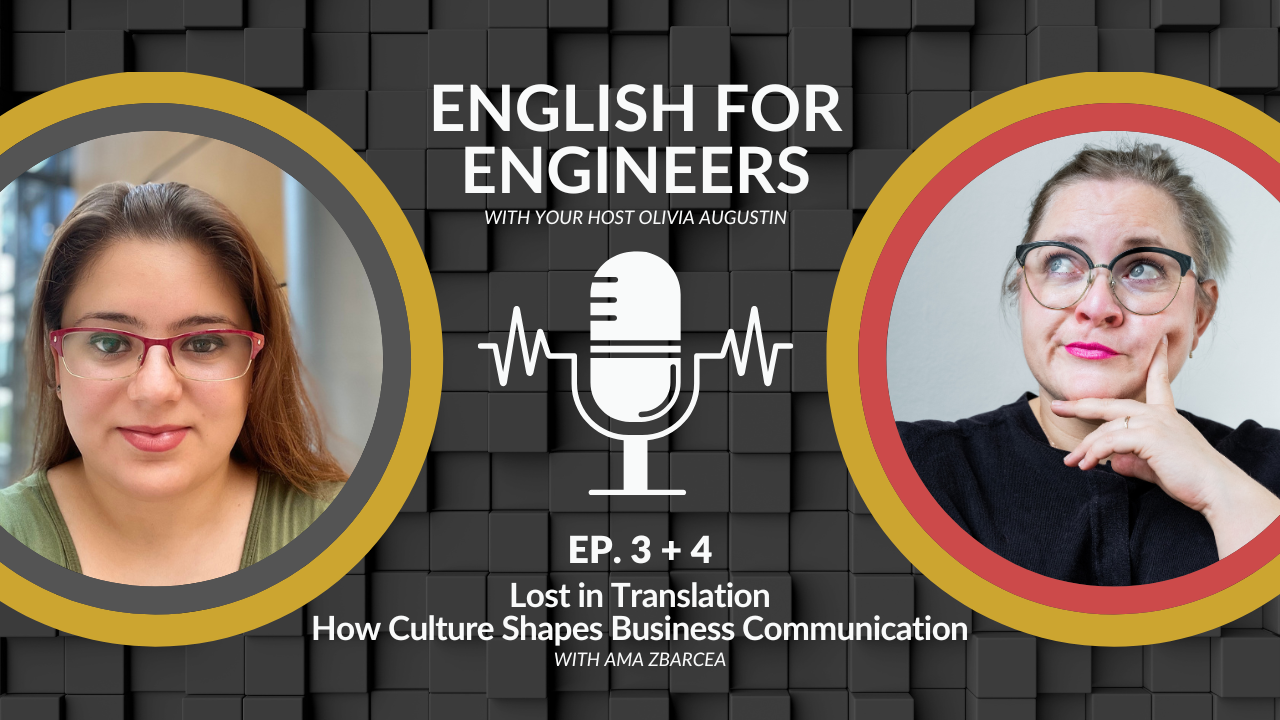
You can have perfect grammar and still get completely misread. That's the whole premise of these two episodes — one long conversation with Ama Zbarcea, split in half because there was too much good stuff to cut.
Ama is a legal expert, a polyglot, and someone who's collected more cross-cultural mishaps than most people collect passport stamps — which, given she holds three of them (American, Romanian, British), tracks. She grew up Romanian-American, moved to London for what was supposed to be a three-month internship, and never really left.
What You'll Learn in These Two Episodes
Say "it's completely my fault" in the US, and it's a shrug — mistakes happen, you own it, you move on. Say the exact same sentence to a British colleague, and you've just confirmed the whole thing genuinely was your fault. Ama and Olivia unpack why identical words carry opposite weight depending on which culture is listening.
A German engineer answers a question in five minutes and gets read as knowledgeable. A Japanese engineer takes a week on the same kind of question — because he's checking with his boss first, standard practice in a more hierarchical culture — and gets read as slow. Neither one is wrong. Ama and Olivia break down Erin Meyer's example and what it means for international project teams.
In the US, a 24-hour reply window is the norm and weekend messages aren't unusual — time is money, literally. In the UK, there's more built-in respect for work-life balance. Neither approach is more "correct." It's just a different default.
A Slovakian colleague once spun around in a quiet London office and shouted "I love you, you're SO rude" after overhearing Ama solve a problem bluntly on the phone. Directness read as a compliment, not an insult, because it wasn't being filtered through British norms.
Ama's actual rule, after years of getting it wrong in three different countries: know your audience, every single time — and don't take yourself too seriously when you inevitably get it wrong anyway.
Sound familiar?
If you've ever sent a message that landed completely wrong on an international team — too blunt, too slow, too direct, too vague — that's not a fluency problem. That's culture doing what it does. Have a look around the site, check the blog, or book a free consultation and we'll figure out where the friction actually is.
Resources and Links
- The Culture Map by Erin Meyer — the book Ama and Olivia keep coming back to across both episodes, especially the German/Japanese email example
- On Your Own Terms — Contract Cheat Sheet — Ama's free, plain-English cheat sheet for reading contracts without a law degree
- Marcode's Free Email-Writing Guide — Olivia's structure and phrase bank for business emails
- 6 Ways To Communicate In International Settings — for the practical toolkit version of everything these two episodes cover as a story
- Read the article "What does 'global mindset' actually mean?"
Connect with Ama Zbarcea
Through her company, On Your Own Terms, Ama offers understandable, affordable, and non-boring legal help for online small businesses so they can grow without legal stress.
- Website: onyourownterms.net
- Free contract cheat sheet: onyourownterms.net/freebie-legally-legit-digital-product-checklist/
- Instagram: @on_your_own_terms_
- Facebook: On Your Own Terms
Connect with Olivia Augustin
Olivia Augustin is a civil engineer and certified English as a second language teacher. With her one-on-one lessons and group courses, she teaches non-native English-speaking engineers the kind of English that gets the job done.
0 Comments