

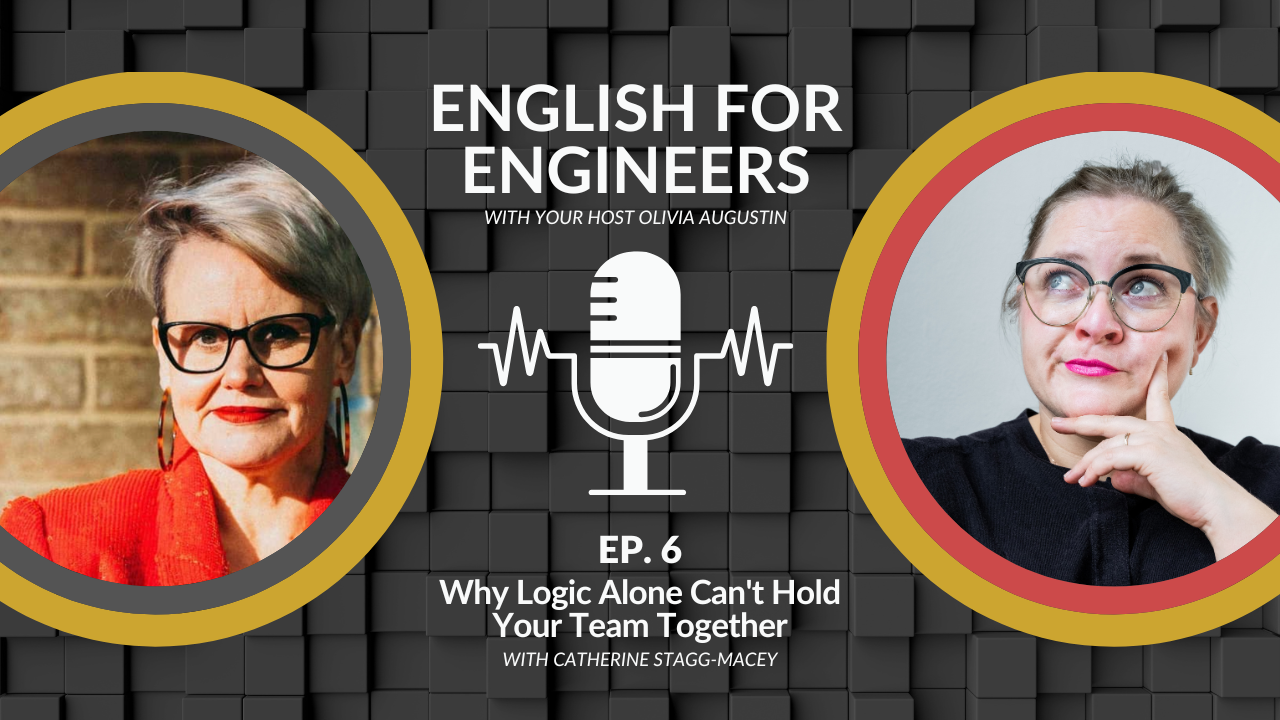
In this episode of English for Engineers, I sit down with Catherine Stagg-Macey, executive coach, team coach, and founder of Conversations at the Edge, to talk about the one skill that keeps international engineering teams from falling apart: empathy. Catherine has spent the last ten years coaching tech and engineering teams through exactly this problem, after twenty years working in tech consulting herself.
What You'll Learn in This Episode
Engineers are trained to be rational: break a problem down, build a solution, calculate the outcome, add a safety factor for what you can't predict. That training is exactly what makes teams messy. A team isn't a calculation. It runs on relationships, and relationships are unpredictable. Most teams don't struggle because the technical work is hard. They struggle because nobody taught anyone how to manage what's underneath it: what you're saying, what you're actually thinking, and what you're doing, often three different things at once, multiplied by everyone else in the room.
Catherine grew up in South Africa, moved to the UK about twenty years ago, and got pulled aside within her first year at a new job and told she was "way too direct." The same directness that was completely normal back home read as blunt in England. Working with Americans taught her something else: they're often more direct than the British, but they deliver it with more warmth. A simple "thanks for your email, it's very interesting" can mean genuine appreciation in one culture and a polite brush-off in another. Olivia's own workaround with her German and Austrian clients: she asks them outright whether they mean a "German how are you" (a real question) or an "American how are you" (a greeting), and lets them choose.
Catherine runs a physical exercise with teams: everyone holds one end of a piece of string, tugging left and right to represent their inner dialogue, the part they're thinking but not saying out loud. Join every person's string together, and you get a tangled web that nobody can see from the outside. That's what's actually happening inside every team meeting. What people say, think, and do rarely lines up, and every extra person and every extra culture in the room adds a layer of tension nobody can point to.
Catherine's answer: it's a muscle, not a personality trait. If you can learn calculus, you can learn empathy. It takes the same willingness to feel uncomfortable and try something that might not work. The payoff is what she calls the "two plus two is five" moment. And it isn't reserved for whoever's running the team, everyone in the room is choosing how they show up, whether they hold the job title or not.
Catherine ran a quick exercise with her coaching clients: think about your last working week, what went well because of you? Almost nobody could remember being told they'd done something well. That gap connects to John Gottman's research on relationships: for every negative comment, a relationship needs roughly five positive ones to stay healthy. Teams run on the same math.
Catherine's closing line: you can insist you're right, or you can be in a relationship with the people you're working with, but rarely both at once. The exercise she uses: two people watch the same rotating finger, one sees clockwise, the other counterclockwise. Both are right. It depends on where you're standing.
The English for Engineers podcast is here to help engineers and technicians from all backgrounds improve their communication skills and provide them with interesting facts so that Technical and Business English becomes their new superpower.
RESOURCES AND LINKS
- Why Engineers Need Emotional Intelligence (And Already Have More Than They Think) — more on empathy and EQ as skills any engineer can build, not just the ones with "people person" written into their job title.
- Soft Skills for Engineers: It Is a Translation, Not a Transformation — more on treating skills like empathy as something you translate into your own working style, not something you're missing.
- 6 Ways To Communicate In International Settings — for more on the directness spectrum Catherine and Olivia get into here.
- Catch up with English for Engineers Lost in Translation: How Culture Shapes Business Communication for another guest conversation on how culture, not just vocabulary, decides whether you're actually understood.
- Let the Drawings Speak: How Engineering Culture Changes Across Borders — if this episode has you thinking about how engineering culture itself shifts across borders.
- Get the newsletter: marcode.org/newsletter
CONNECT WITH CATHERINE STAGG-MACEY
Catherine Stagg-Macey is an executive and team coach, and the founder of Conversations at the Edge. After twenty years in tech and consulting, she has spent the last ten coaching mid-career professionals and teams through the kind of cross-cultural friction covered in this episode.
CONNECT WITH OLIVIA AUGUSTIN
Olivia Augustin is a civil engineer and certified English as a second language teacher. With her one-on-one lessons and group courses, she teaches non-native English-speaking engineers the kind of English that gets the job done.
0 Comments