

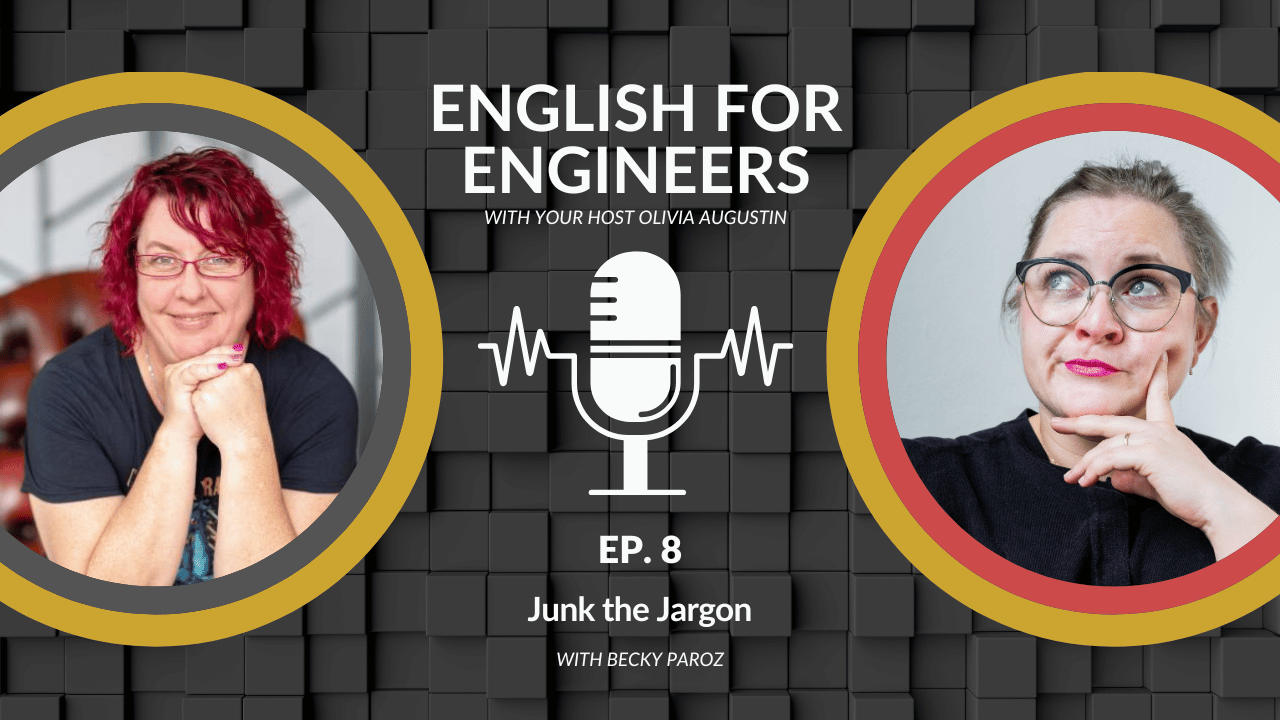
In this episode of English for Engineers, I sit down with Becky Paroz, a 30-year veteran of the Australian construction industry, engineer, project manager, and quality assurance specialist, to talk about why industry jargon might be costing your international team more than you think — and what to do about it instead.
What You'll Learn in This Episode
Becky describes jargon as a kind of membership card — a shorthand industries use to signal who's inside the club. That's true even among native English speakers: the terms used on one job site aren't always the terms used on the next. For anyone joining the conversation from outside that specific circle — including non-native speakers — the club gets very small, very fast.
After years reviewing internationally translated technical documents, Becky learned to spot the difference immediately. A language-first translation reads smoothly but can lose the technical precision, turning something like "tighten the screw ten times, then back off half a turn" into a vague "screw it in until tight." A technical-first translation might read awkwardly, but it keeps the tolerances, steps, and part references intact — the details you genuinely can't work without.
It's Becky's go-to example of why native speakers can't assume they're understood just because they're speaking English. "No worries" can mean "it's sorted," "we'll figure it out," "I heard you but I'm brushing this off," or simply "you're welcome" — four different messages in one phrase. Her advice: when a response doesn't quite add up in context, ask again, specifically.
Learn one curse word in a colleague's native language — not to use it, but to recognise it, since people tend to revert to their first language the moment something goes wrong on site. Then learn one warm, ordinary word too. When Becky mangles a Dutch word while trying to pay someone a compliment, the Dutch person worries less about mangling an English one. Offering imperfection first gives everyone else permission to be imperfect too.
The English for Engineers podcast is here to help engineers and technicians from all backgrounds improve their communication skills and provide them with interesting facts so that Technical and Business English becomes their new superpower.
RESOURCES AND LINKS
- How to Work in an International Engineering Team: Practical Tips That Actually Work — the full deep-dive built from this same conversation: the complete document checklist, the "learn their stress word" trick in detail, and why cultural differences trip people up harder than language ones.
- Emails for Engineers — engineer-written email templates, for when jargon and unclear phrasing are costing you time in writing, not just on site.
- Technical English — the Fast and Furious Edition — if documentation and jargon are where your international team keeps losing time in translation, this group course is built for exactly that.
- Let the Drawings Speak: How Engineering Culture Changes Across Borders — another angle on how work culture shifts when you cross a border, this time through number-heavy vs. document-heavy engineering reporting.
CONNECT WITH BECKY PAROZ
Becky Paroz has spent 30 years in the Australian construction industry as an engineer, project manager, and director across three companies. She's also a professional mentor to the next generation of industry leaders and was named Fearless Educator of the Year in 2019. Becky ran Queen B Project Systems, a Brisbane-based consultancy.
CONNECT WITH OLIVIA AUGUSTIN
Olivia Augustin is a civil engineer and certified English as a second language teacher. With her one-on-one lessons and group courses, she teaches non-native English-speaking engineers the kind of English that gets the job done.
0 Comments