

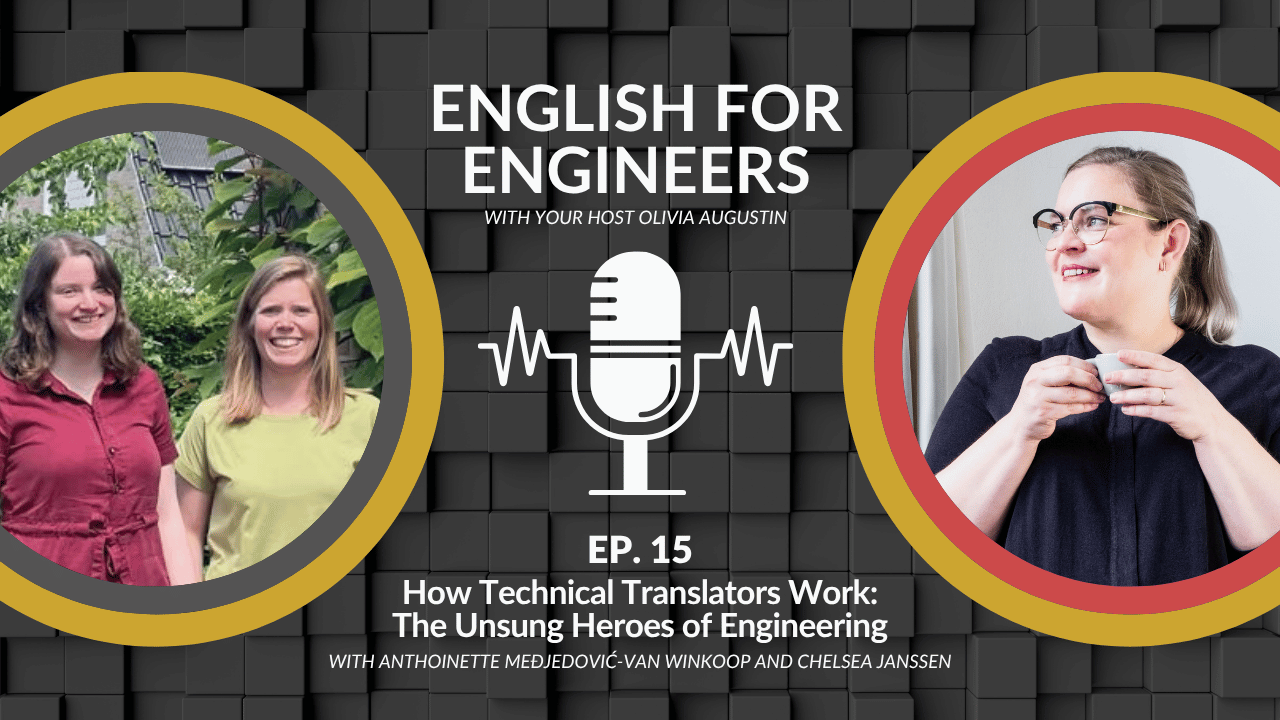
Clients ask Olivia to translate their documents all the time — a tender spec, a contract, a manual. She always says no. Not because she won't help, but because teaching English and translating are two different jobs, with two different kinds of training.
So she invited two people who do the second job for a living: Anthoinette Međjedović-van Winkoop and Chelsea Janssen from HTT – Helena Technical Translations. This episode is a look behind the scenes of a profession most engineers never think about — until a deadline makes them.
What You'll Learn
Translation is written; interpreting is spoken, often live and simultaneous, like the voice over your headphones at a conference. Two different skills, two different kinds of training. Both aim for accuracy; neither one guesses.
More than you'd think. The file gets analysed, checked for format and repetitions, matched against a translation memory if you're a returning client, then translated by a subject-matter specialist, reviewed by a second linguist, and quality-checked before it comes back to you.
No text leaves the building after only one person has looked at it. Every translation is done by one qualified linguist and reviewed by a second — four eyes, minimum. It's the backbone of HTT's ISO 17100 certification, and it's the single idea from this episode you can borrow for your own writing.
Because a manual carries warnings, safety steps and operating limits. A mistranslation doesn't stay on the page — it reaches the person using the machine. As Olivia puts it: good thing IKEA switched to pictures. Real manuals don't have that luxury.
Three things: time (don't leave translation to the last five minutes of the project), context (send the source file, not an isolated list of words), and terminology (a rough term list in even one language is gold). More of each means more quality at the end.
The bit that stuck with Olivia: be your own reviewer. Translators run a structured quality assessment, not a vibe check. You can do the same with your own English; and that's exactly what the companion article walks through.
Every episode of English for Engineers is here to help you communicate clearly and confidently in international work — without the fluff.
Resources and Links
- Read the companion article: What Engineers Can Learn From Professional Translators
- HTT – Helena Technical Translations: helenatranslations.com
- Want to check your own English the way a reviewer would? Technical English Guidelines (free)
- New here? Unstuck Your English (free)
- Related listening: Lost in Translation: How Culture Shapes Business Communication
Connect with HTT – Helena Technical Translations
Helena Technical Translations is known as a customer-oriented technical translation agency. Large international enterprises and SMEs have relied on their highly qualified and experienced translators since 1991. All their translators are genuine native speakers and linguists, and specialize in one or more fields. They are ISO 17100-certified, which reinforces their quality guarantee.
Go to the HTT Website | Instagram
Connect with Olivia Augustin
Olivia Augustin is a civil engineer and certified English as a second language teacher. With her one-on-one lessons and group courses, she teaches non-native English-speaking engineers the kind of English that gets the job done.
0 Comments