

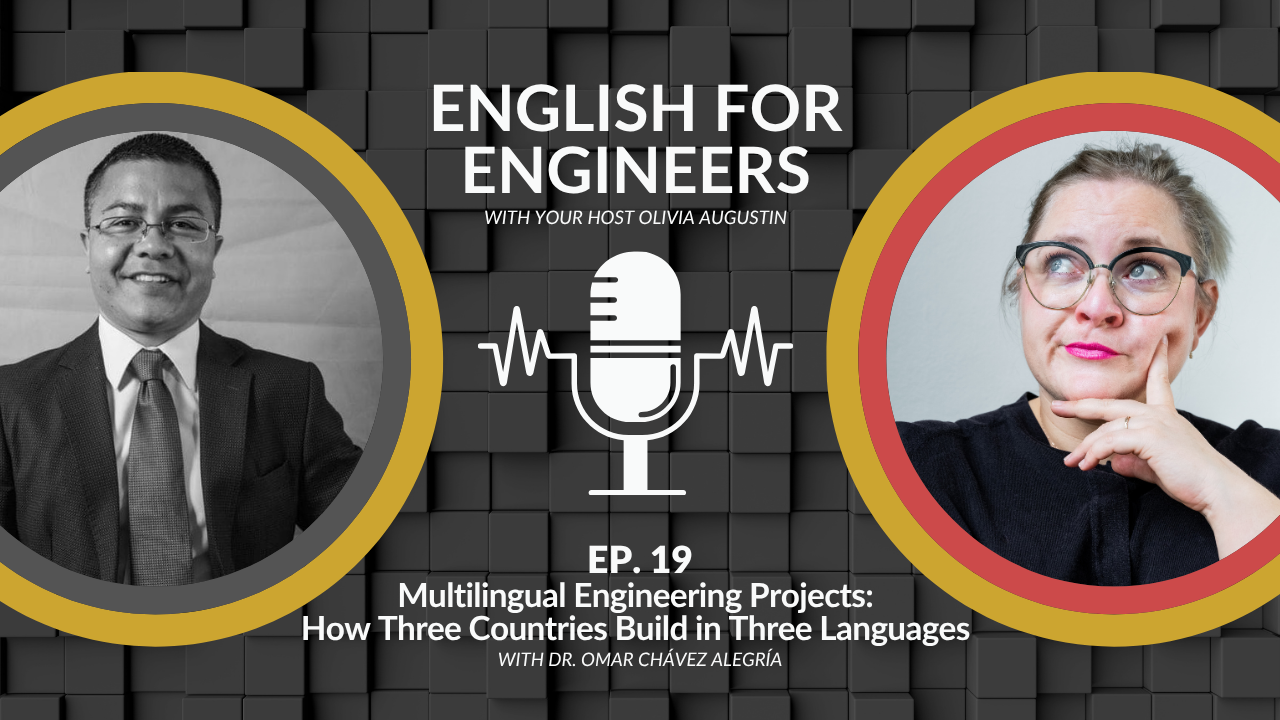
Most engineers accept that international projects run in English. Then they meet a project that runs in three languages at once.
My guest is Dr Omar Chávez Alegría, a civil engineer, professor and researcher at the Universidad Autónoma de Querétaro in Mexico. He works with the Eco-Innovation Network, a research collaboration between universities in Mexico, the United States and Canada. The network sits under the Commission for Environmental Cooperation, an intergovernmental body headquartered in Montreal.
The CEC publishes every technical report in English, French and Spanish. Every public meeting runs with live interpretation in all three. That is a design decision, and it costs money. Omar explains why the three countries pay for it anyway.
Then there is the part nobody plans for. On a site in Yucatán, the crew speaks Maya. In central Mexico it might be Ñañu. Your Spanish specification will not reach them.
We also cover monarch butterflies, water filtration in mining communities, and why civil engineering is a much bigger field than most students realise.
What You'll Learn in This Episode
JPAC advises the CEC Council on environmental matters across North America. It has nine members, three from each country. Members serve as individual citizens rather than as government representatives. Their job is to bring regional and community perspectives into decisions that would otherwise be made at national level.
Translation converts written documents from one language into another. Interpretation happens live, while people are speaking. The CEC uses both. Reports get translated into three languages. Meetings get simultaneous interpretation. Omar makes the case that live interpretation changes who can actually take part in a discussion.
There is rarely one answer. The contract language, the meeting language and the site language can all differ. Omar's projects run in English at network level, Spanish at national level, and a local language on site. Engineers who work across borders need to know which layer they are operating in.
An annual competition that invited students and young entrepreneurs from Canada, Mexico and the United States to submit environmental innovations. Omar describes projects on microplastic pollution, biodegradable tableware made from mushroom fibre, and UV robots that treat crops in the field. The CEC ran the challenge from 2017 to 2023.
No. Omar's work spans water quality, heavy metal contamination in mining communities, biodiversity monitoring and cross-border policy. Olivia studied civil engineering and says the same thing: the field is far wider than most people realise when they start.
Guest Lectures for Engineering Faculties
This episode exists because Omar invited me to teach. Before we recorded, I gave a guest lecture to his students at the Facultad de Ingeniería in Querétaro on what Technical English actually is and why it matters for engineers. Ninety minutes, very good questions, one of the liveliest sessions I have had.
It was not the first. I have also given a guest lecture on presentation skills for engineers at a university in Colombia.
If you teach engineering, run an international programmes office, or work in a university language centre, your students are heading into exactly the kind of multilingual project Omar describes. I can come and talk to them about it.
Start with a free 30-minute call. Nothing to prepare — just tell me what your students are dealing with and I will tell you whether I can help.
Resources and Links
- Commission for Environmental Cooperation — reports, data and open-access publications in English, French and Spanish: cec.org
- Joint Public Advisory Committee — how JPAC works and who serves on it: cec.org/about/joint-public-advisory-committee
- Youth Innovation Challenge — archive of the 2017–2023 editions: cec.org/topics/youth-engagement/youth-innovation-challenge
- Read the companion article — the language and vocabulary side of this conversation, including the Maya terms Omar uses on site: Why Engineers Need More Than One Technical English
Connect with Dr. Chavéz
Dr. Omar Chavéz Alegría is the department head of the Facultad de Ingeniería at the Autonomous University of Queretaro, where he fills the roles of a professor and researcher.
Linkedin | University Website
Connect with Olivia Augustin
Olivia Augustin is a civil engineer and certified English as a second language teacher. With her one-on-one lessons and group courses, she teaches non-native English-speaking engineers the kind of English that gets the job done.
Work with me | Get the newsletter | LinkedIn | Instagram
0 Comments