

Engineering isn't the same everywhere. The physics and the math are universal, but how you present a project, write a report, or run a meeting changes completely depending on which country you're working in.
As an engineer working with international clients, that's not just a cultural curiosity. It changes how you need to communicate your ideas in English, too. And here's the useful part: once you know the quirks of the culture you're presenting to, people notice your English mistakes a lot less.
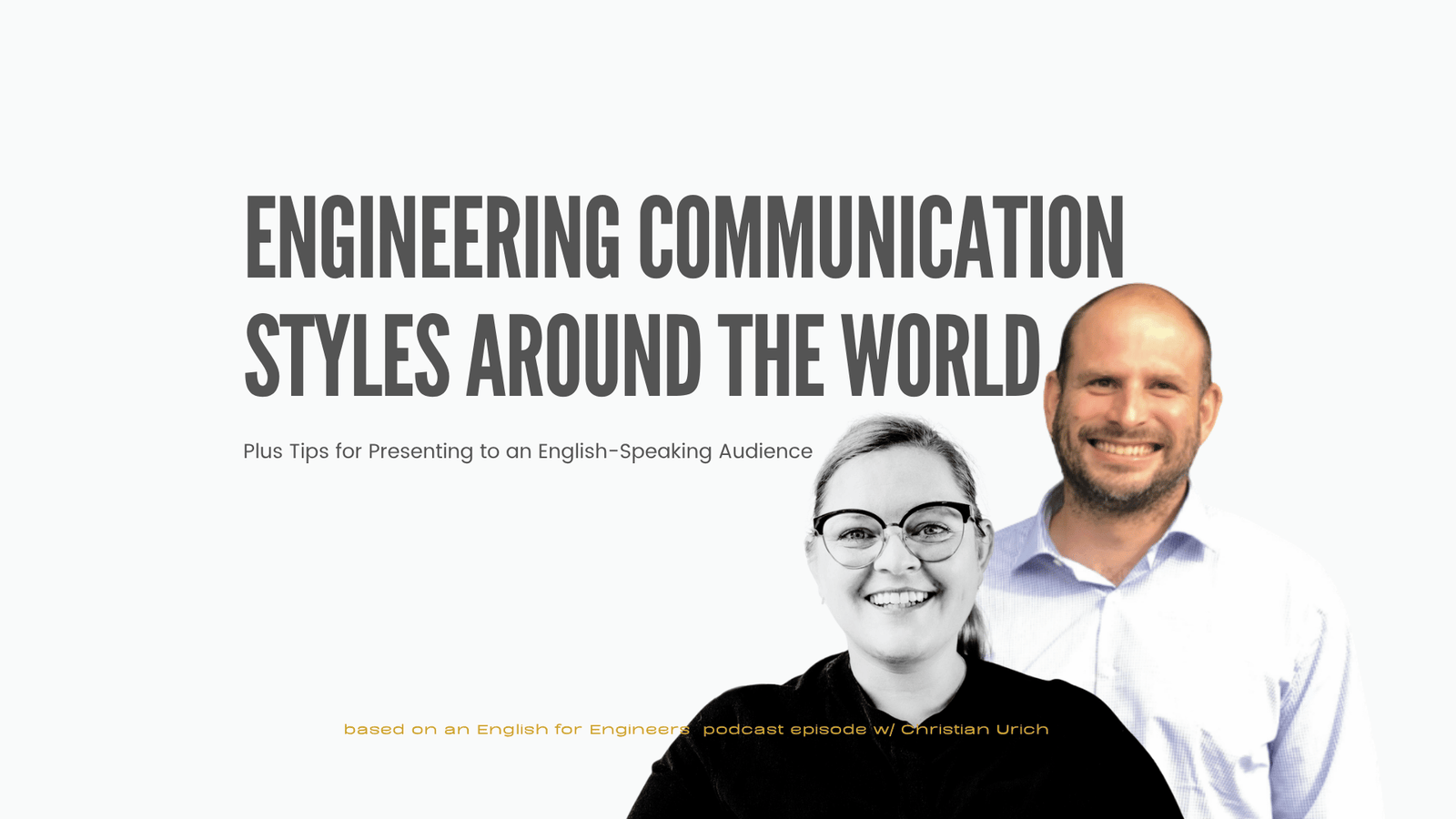
Recently, I sat down with my old school friend Christian Urich to talk about exactly this. Christian trained as a structural and computational engineer in Austria, earned his PhD at the University of Innsbruck, and now works in sustainable urban development in Australia — so he's lived both sides of this divide. Since we're both Austrian, we started with the differences between engineering in German-speaking and English-speaking countries.
Let's break down what makes each unique.
Engineering in Austria/Germany
Both Christian and I were educated and worked as engineers in Austria, so we know this work culture well. One phrase sums it up: "Let the drawing and numbers speak for themselves."
In practice, that meant:
- A cover sheet with a table of contents
- Pages, sometimes metres, of numbers and drawings
- Almost no narrative writing at all
My Austrian professors told me that writing wasn't important for engineers, because the drawings and numbers could be trusted to speak for themselves. Anything more went against our national engineering culture. That was back in the '90s, mind you.
If you chose engineering because "words aren't your thing," this sounds like a dream. But it's also why so many engineers struggle the moment they realise communication is a large part of the job, especially with overseas clients.
Outside the German Bubble
When I talk with other European engineers, say from the Netherlands or England, I notice they work differently than the engineers I trained with in Austria and Germany.
Project management frameworks like SCRUM or AGILE are far more common in places like the Netherlands. These tools were originally built for the IT world, but they found their way into big infrastructure projects too, at least in my experience there.
Like Austria and Germany, Europe still has plenty of small, highly specialised engineering companies, some of which take on work across Europe, Russia, and even the Middle East. Each country tends to have its own niche. Austrian engineers, for instance, are known for tunnelling technology.
Communication style shifts too. Outside Germany and Austria, you're less likely to see numbers-based reporting and more likely to see document-based or even model-based systems engineering, as in the Netherlands.
Engineering in Anglo-American Realms
Whether you're working with an Australian, New Zealander, American, Canadian, or British firm, English-speaking engineering tends to run on a different system than European engineering.
For one, there are far more large firms. Instead of a small, specialised company focused on one thing, you'll find large firms that do everything, which changes how projects get planned and run.
But the real difference is document-based engineering. German-speaking countries love numbers. English-speaking companies want numbers too, but interpreting them is what matters most.
Most expect a one-page report with every project update, regardless of how big the project is. In that report, you need to:
- Say what the number means, not just report it
- Position yourself as the expert interpreting it
- Explain specifically how it should shape a decision
Clients often only read the executive summary, so it has to carry the important information on its own. If they want more, they can dig into the numbers and drawings themselves.
For my word-scared engineers, this means you have to write. Instead of letting the numbers speak for themselves, you need to speak for the numbers. It's less scary than it sounds.
Tips for Presenting to an English-Speaking Audience
- If you're from a German-speaking country, interpret the data yourself. Don't expect English-speaking clients to dig through mountains of numbers and figure it out.
- Think about who's reading it. Are they an industry expert, or do they need engineering terms explained?
- When you hit a calculation that needs interpreting, ask yourself: what should the reader actually do with this?
- This isn't dumbing the numbers down. It's translating them into something your client can use.
- Give your report a clear structure and narrative, not just a list of facts.
- Keep it to one page. There's no room for fluff when you've got to fit all your interpretation into a single sheet.
- Make it convincing. The goal is for the reader to take action, whether that's digging deeper, making a change, or hiring you again.
That kind of adaptability is really just a global mindset in action — something every engineer working across borders needs to build.
FAQ
German-speaking firms tend to let numbers and drawings speak for themselves, with minimal narrative. English-speaking firms expect a written, document-based report that interprets what those numbers mean.
No. Frameworks like SCRUM and AGILE are common in places like the Netherlands, and each country tends to specialise, Austrian engineers in tunnelling, for example. Communication style shifts by country too, not just by continent.
It means the numbers are only the starting point. The engineer's job is to interpret them in writing, usually in a short report, so a non-specialist reader can understand what they mean and what to do next.
Start by asking what the reader will do with each number. Write a short, structured summary that interprets the data instead of just presenting it, and keep it to one page.
Does this feel like a lot to take in? You'll want the next post on writing in business English and building confidence with it, too.
In the meantime, catch the full conversation with Christian on the podcast, "Let the Drawings Speak", where we get into even more of these cultural quirks.
Want to talk through how your own team's communication style compares? Book a free 15-minute call and let's find out.
Original Post from 10 November 2022; latest update: 18 August 2026.
0 Comments